Background of the New Policy: The Impact of Surging Low-Value Parcels
The 27 member states of the European Union recently reached a significant agreement aimed at addressing the growing problem of low-value parcel imports. Official data shows that since 2022, the number of small cross-border parcels entering the EU has nearly tripled, and is projected to reach a staggering 4.6 billion items for the full year of 2024. Currently, around 12 million parcels valued under €150 enter the EU daily, benefiting from a customs duty exemption. This situation creates immense unfair competition for domestic retailers in countries like Spain and poses regulatory challenges for customs, making it difficult to effectively verify whether products comply with EU safety and environmental standards.
A Transitional Tariff: A Temporary Solution for Data System Delays
To address the root of the problem, EU member states had previously agreed to abolish the tax exemption for small parcels under €150, a policy in place since 1983. However, the new customs data hub designed to process the massive volume of parcel data is not expected to be fully operational until 2028. To bridge this gap, the member states have decided to implement a transitional mechanism. Under the agreement, from July 1, 2026, until the new system goes live, all eligible low-value parcels will be subject to a standard tariff of €3 per order. It should be noted that this tariff is separate from the €2 administrative fee proposed by the European Commission, which has not yet been approved.
Targeting Emerging E-commerce Platforms to Reshape the Market
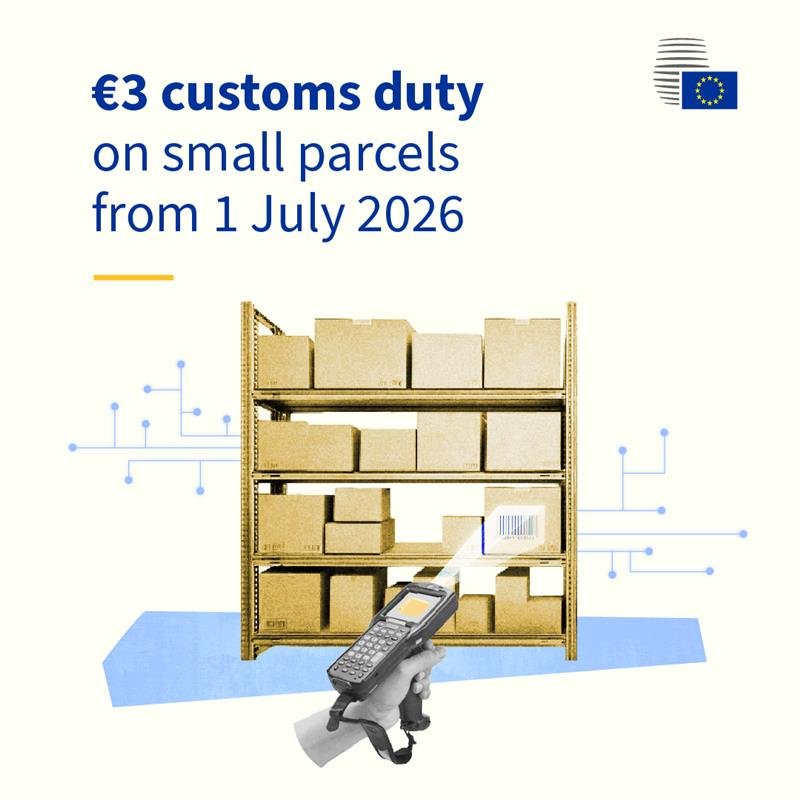
This new tariff policy is widely seen as the EU’s response to the rapid rise of cross-border e-commerce platforms like Temu and Shein in recent years. These platforms have expanded rapidly in the European market with their highly competitive prices, but have also exacerbated imbalances in the EU’s domestic market. By introducing this tariff as an economic lever, the EU aims to rebalance the competitive landscape between local businesses and cross-border e-commerce giants, ensuring that all goods sold in the EU market operate under a fairer tax framework.
The Far-Reaching Impact of the Policy Shift
The agreement marks a major policy shift for the EU regarding cross-border e-commerce taxation, moving from exemption to universal collection. This change is expected to have a profound impact on the future landscape of cross-border retail trade between the EU and China, and even globally. For cross-border e-commerce sellers and platforms that rely on the EU market, the new tariff costs will directly affect their pricing strategies and profitability, potentially prompting a new round of adjustments and optimizations to industry supply chains and logistics models.
