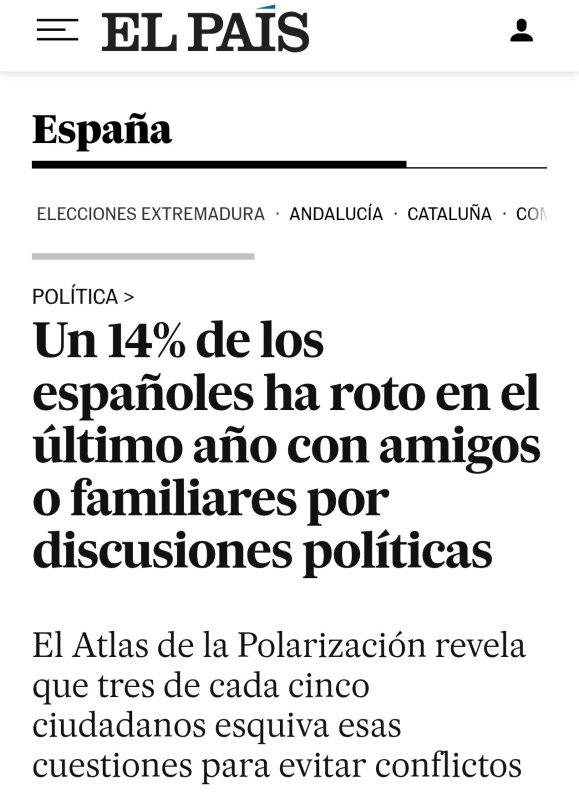
A sociological research report published in 2025 shows that political polarization is causing substantial harm to Spain’s social fabric and interpersonal relationships. The study found that as many as 14% of Spaniards have chosen to cut ties with friends and family due to disagreements on political issues. This phenomenon is particularly pronounced during family gatherings like holidays.
The Social Alienation Behind the Numbers
Data shows that in addition to directly cutting ties, another 15% of respondents have chosen to leave social media groups, such as on WhatsApp, because they cannot tolerate the political arguments within them. This “silent distancing” is especially prominent among voters of the Podemos party. To maintain harmony, as many as three-fifths of Spaniards state they consciously avoid political topics when talking with friends and family, reflecting a shrinking space for public discourse.
Social Patterns Across the Political Spectrum
The study’s lead researcher, sociologist and political scientist Tarek Jaziri Arhona, points out significant differences in the social behaviors of supporters of different parties. Voters for Vox tend to associate only with people who share their political views, resulting in fewer relationship breakdowns due to political disagreements within their circles. In contrast, while supporters of Podemos and Sumar claim to have more diverse social circles, they are also more likely to cut ties with friends or family over conflicting viewpoints.
Immigration: The Most Explosive Topic
Among all political topics, immigration has proven to be the most controversial and emotionally charged issue in Spanish society. The root of this division lies not just in differing stances, but in the extreme polarization of opinions. On this issue, supporters of Podemos and Sumar share similar views, while Vox supporters stand in complete opposition. Supporters of the People’s Party (PP) and the Spanish Socialist Workers’ Party (PSOE) hold more centrist positions but lean towards opposing blocs, leaving almost no room for compromise when discussing the matter.
The Entrenchment of Two Political Blocs
The study concludes that Spanish society is gradually forming two entrenched political blocs: one consisting of Vox and the PP, and the other centered around the PSOE, Sumar, and other left-wing parties. Within the same bloc, voters have a higher degree of emotional affinity; towards the opposing bloc, negative feelings are intensifying. In contrast, while disagreements also exist on issues like healthcare, education, and taxation, the positions are more clustered, leaving room for discussion and overlap, unlike the issue of immigration, which more easily triggers irreconcilable conflicts.
