Spain’s Income Map Reveals: Wealth Divide Pinpointed to the Street Level
Spain’s National Statistics Institute (Instituto Nacional de Estadística, INE) recently released its “Atlas of Household Income Distribution” (Atlas de distribución de renta de los hogares). By analyzing income data from census tracts across the country, the report highlights significant regional wealth disparities in Spain. Although the data shows that household income has increased in almost all areas, the imbalance in wealth distribution remains prominent, especially within large cities, where the street one lives on often becomes an invisible dividing line for socioeconomic classes.
Core of the Report: Income Measured by “Household Consumption Units”
To more accurately reflect the actual living standards of households of different sizes, the report uses the “median income per household consumption unit” as its core metric. This method counts the first adult in a household as 1 consumption unit, other members aged 13 and over as 0.5 units each, and children under 13 as 0.3 units. This approach considers both total household income and demographic structure, making cross-regional comparisons more scientific.
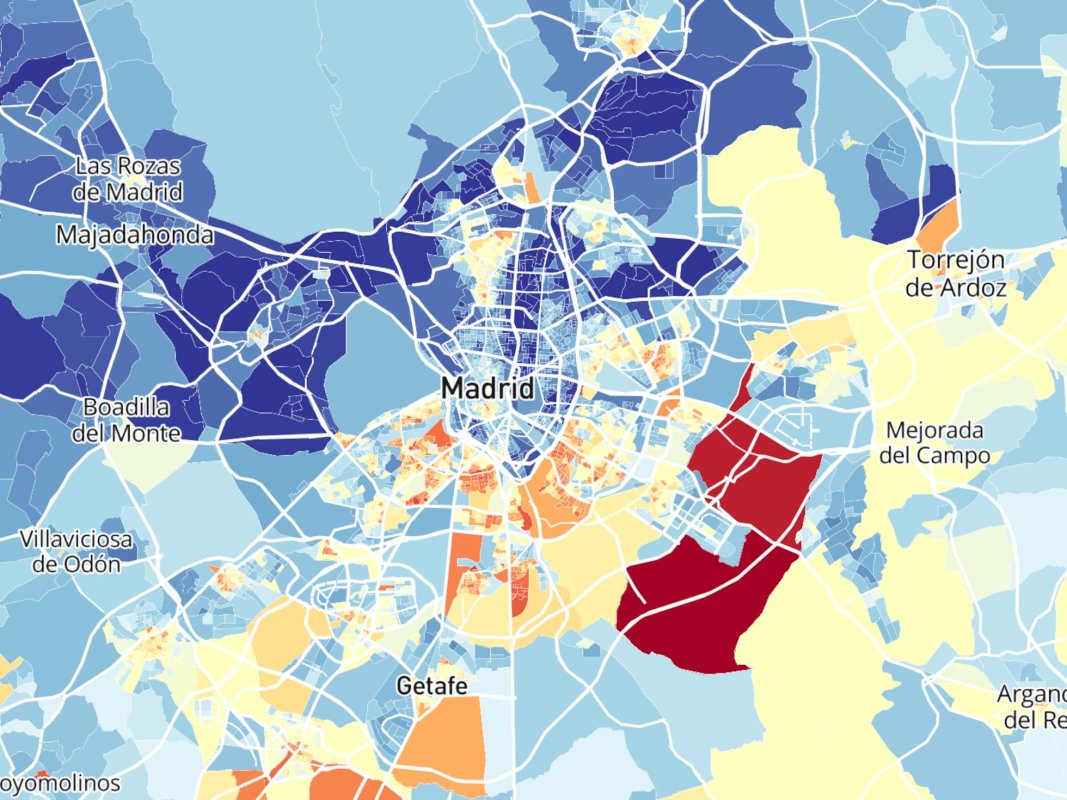
High-Income Areas: The Concentration Effect in Madrid and Barcelona
The data shows that Spain’s high-income class is highly concentrated in the metropolitan areas of Madrid and Barcelona. Of the 491 high-income census tracts in the country with incomes exceeding €37,500, 306 are located in the cities of Madrid and Barcelona, with another 124 in affluent surrounding towns such as Pozuelo de Alarcón near Madrid and Sant Cugat del Vallès near Barcelona.
The two wealthiest census tracts in the country are both in Pozuelo de Alarcón, where the median income per household consumption unit exceeds €37,450. By this standard, a typical family of four (two adults and two children) in these areas would have a net annual income of over €78,000.
Low-Income Areas: Challenges in Southern and Eastern Cities
Meanwhile, low-income areas are mainly concentrated in cities in southern and eastern coastal Spain. Of the 609 census tracts with the lowest incomes in the country (below €7,350), 50 are in Sevilla, 30 in Alicante, and 24 in Málaga. Notably, the capital city of Madrid also has 23 census tracts in this category.
The three lowest-income areas in the country are District 6 (El Príncipe) in Ceuta, District 6 (Los Colorines and Santa Engracia) in Badajoz, and District 5 (Mondéjar) in La Línea de la Concepción. In these areas, a family of four of the same size would have a net annual income of only about €21,000, averaging around €1,700 per month.
Within Cities: Significant Income Polarization
The report also highlights drastic income polarization within some cities. For example, in Barcelona, all neighborhoods in the Sarrià-Sant Gervasi district are in the top 20% of the wealthiest in the country. In Madrid, however, the Latina district shows a “mixed” character: 22% of its neighborhoods are among the nation’s wealthiest 20%, while 39% fall into the poorest 40% bracket. Similar internal income disparities also exist in Madrid’s San Blas and Tetuán districts, Barcelona’s Nou Barris district, and Bilbao’s Rekalde district.
