Overall Trend: Madrid Leads the Nation
According to Q4 2025 data released by the appraisal firm Tinsa, second-hand home prices across Spain are on the rise, posting a year-over-year increase of 13.1%. Madrid stands out among major cities with a remarkable 20.9% surge, pushing the average price to €4,883 per square meter. In comparison, Barcelona saw a more modest 8.3% rise, a figure that reflects its substantial price hikes in preceding years. The data indicates that traditionally lower-priced areas are now experiencing the most significant growth.
The Core Conflict: Seven Households for Every New Home
The root cause of soaring housing prices is a severe mismatch between supply and demand. Nationwide over the past five years, for every new home constructed, three new households were formed. The problem is even more acute in Madrid and Barcelona, where each new housing unit is sought by seven new households. This critical supply shortage is the primary engine driving relentless price increases.
Regional Divergence: Usera’s Astonishing Price Hike
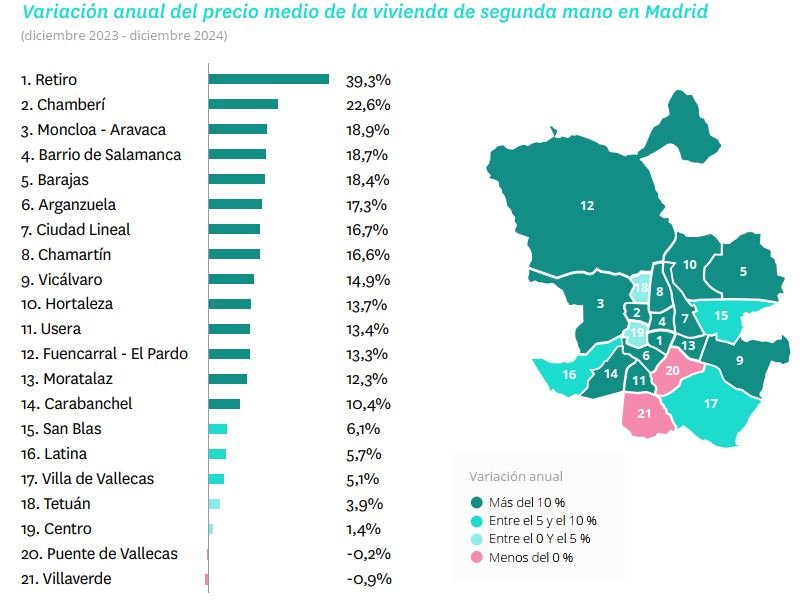
Within the city of Madrid, the Usera district is leading the charge with a staggering 19.9% annual price increase. Close behind are Puente de Vallecas and Chamartín, both recording 18.6% growth. With new developments in prime central locations being predominantly high-end and expensive, and more affordable options relegated to poorly connected suburbs, many homebuyers—particularly those reliant on public transportation—are forced to look at rapidly appreciating yet still comparatively “affordable” inner-city districts. Usera perfectly exemplifies this shift.
Market Structure and Homebuying Pressure
Interestingly, while the city-wide average price in Madrid jumped by a massive 20.9%, no single district’s growth rate actually reached this figure. This points to a structural market shift: the growing prevalence of high-end districts and luxury properties is inflating the overall average. This trend is driven by domestic and international investors whose purchasing power isn’t tied to local wages, alongside existing homeowners looking to upgrade. Concurrently, the market share for first-time buyers continues to dwindle.
The Crushing Burden of Homeownership
With prices rising approximately seven times faster than inflation and six times faster than wages, homeownership in Madrid has become exceptionally challenging. Calculations show that a typical couple would need to allocate 56.1% of their disposable household income to their mortgage, the highest affordability burden among Spain’s major cities. This figure skyrockets to 78.3% in central districts and remains a high 37.9% even in the more accessible Villaverde area.
