Since January 1st of this year, Spain has mandated that all vehicles be equipped with the new V16 smart warning light. When activated, this device automatically sends the vehicle’s geolocation to the cloud platform of the Spanish General Directorate of Traffic (DGT), aiming to facilitate a rapid response to incidents. However, this new regulation, intended to enhance road safety, has ignited a fierce debate over public security due to the public nature of its data.
Public Location: A Safety Net or a Security Flaw?
The most forceful criticism of the new regulation comes from within law enforcement itself. The professional association of the Civil Guard, JUCIL (Justicia para la Guardia Civil), has warned that the location data from the V16 light can be accessed in real-time by any anonymous individual, which “opens a dangerous door” for criminals. The association is concerned that criminal gangs could easily target vehicles that break down in remote areas, particularly at night, and exploit the driver’s isolation and vulnerability to commit robberies. JUCIL argues that this move not only compromises road safety but also threatens public security, and calls for an audit of the system to restrict access to the location data strictly to national security forces and law enforcement agencies.
In response, Spain’s Minister of the Interior, Fernando Grande-Marlaska, has claimed that the geolocation “poses no risk whatsoever to drivers.” He stressed that since traffic authorities can instantly learn the location of a broken-down vehicle and issue an alert to all units, this will “markedly reduce risk,” rather than increase it.
The “Pirate Tow Truck” Problem and Organized Crime Risks
Another association, the Unified Association of Civil Guards (AUGC), has highlighted a different kind of risk. While they believe there’s no need to panic about roadside robberies for now, they warn that the publicly available location data could foster a “pirate tow truck” industry. These unauthorized towing services could arrive at the scene before the official recovery vehicles dispatched by insurance companies, taking advantage of the driver’s distress to provide unsolicited services and demand exorbitant fees of hundreds of euros to release the car.
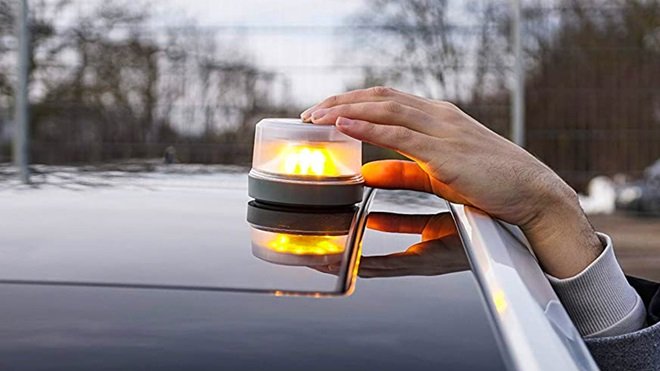
More seriously, Diego Madrazo, a traffic coordinator for AUGC, points out that organized networks specializing in the theft of high-end vehicles could also exploit this function. They could precisely locate and steal a vehicle when it breaks down, quickly transporting it across the border. To address this, AUGC recommends that the visibility of the location signal should be restricted within a “geofence” of two to three kilometers around the incident, instead of being publicly accessible nationwide.
Practical Effectiveness Questioned: Brightness, Battery Life, and Usability
Beyond the security concerns, the practical effectiveness of the V16 light is also under scrutiny. Madrazo bluntly states that a vehicle’s built-in four-way hazard flashers are “much more visible than the V16 beacon.” He fears that the new device’s insufficient visibility could lead to a rise in rear-end collisions, pointing out that even official police beacons, which are significantly brighter than the V16, are often hit.
Furthermore, the device’s battery life is a significant drawback. Based on certification standards, the V16 light only guarantees 30 minutes of operation, while roadside assistance typically takes much longer. Once the battery is depleted, the vehicle loses both its light and its location signal, turning it into an “invisible obstacle” on the road. Moreover, given that the average vehicle age in Spain exceeds 14 years and the digital divide affecting many elderly drivers, a large number of motorists are unable to receive alerts through in-car navigation systems, which significantly reduces the system’s warning effectiveness on regular roads.
