Police-Citizen Interaction Sparks New Road Safety Debate
Recently, a video has gained attention on Spanish social media: it shows a Guardia Civil de Tráfico (Traffic Civil Guard) patrol car parked behind a broken-down vehicle, using its own lights to provide extra protection for the driver. Reportedly, the driver had already placed the mandatory V16 emergency beacon on the car’s roof. This incident, while praised as “timely assistance,” has also resurfaced the debate over the effectiveness of the V16 device.
Daytime Alert Effectiveness Becomes Main Point of Contention
The biggest controversy surrounding the V16 beacon is its warning effectiveness during the day. Many drivers argue that, compared to traditional warning triangles, the V16 light’s visibility and range are significantly insufficient in daylight. Monserrat Estaca, a relevant official from the Dirección General de Tráfico (DGT), has even admitted that the device’s warning capability is indeed weaker in sunny conditions. Although DGT Director Pere Navarro later stated that warning triangles can still be used as a complementary measure, this has not fully allayed public concerns.
Warning Limitations in Complex Road Conditions
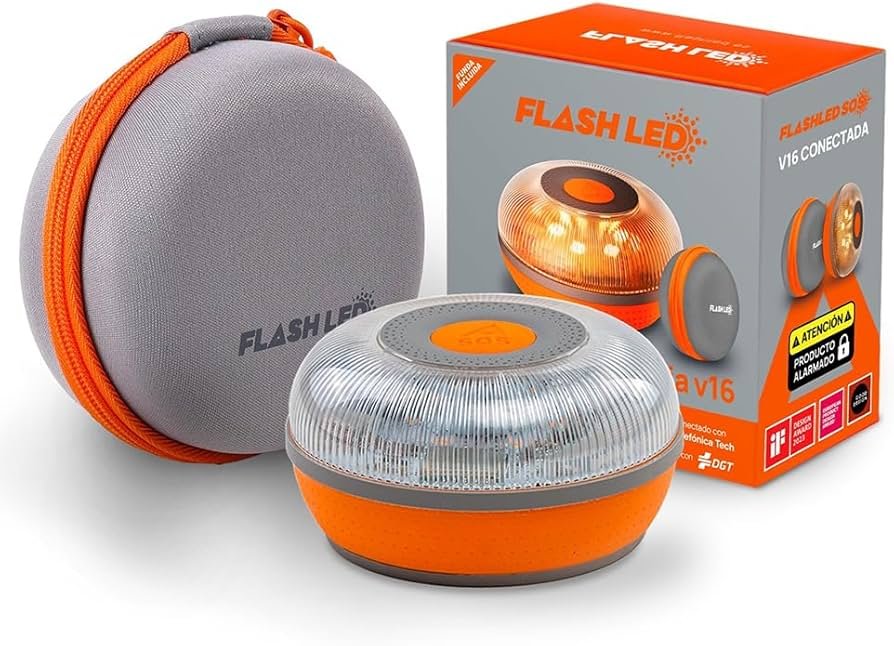
Beyond its daytime performance, the V16 light’s limitations in specific road conditions are also a major concern. Some drivers point out that even at night, if a vehicle is stopped on a curve or a hill where the line of sight is obstructed, the flashing V16 light may not be spotted in time by distant vehicles. This greatly diminishes its early warning effect, failing to fundamentally solve safety hazards in all scenarios.
“Smart Connectivity” Feature Faces an Uncertain Future
As a next-generation emergency device, the connected V16 beacon can transmit the vehicle’s breakdown location to the DGT’s cloud platform. However, its practical utility is being questioned. Critics argue that on roads without variable-message signs, this feature offers very limited direct help to other drivers. Furthermore, whether this data can be efficiently integrated with major navigation apps like Waze and Google Maps to provide real-time alerts to a broad user base is still an unknown, challenging the realization of its “smart” value.
