Headline and Core Inflation Both Decline
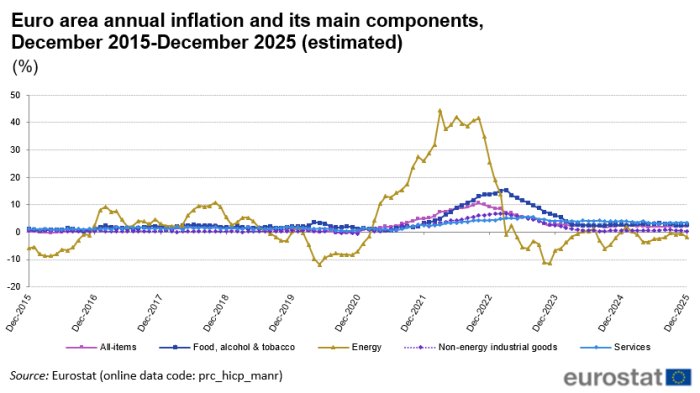
According to data released by Eurostat in January 2026, the annual Consumer Price Index (CPI) increase in the Eurozone narrowed to 1.9% in December 2025, down from 2.1% in November and below the European Central Bank’s (ECB) medium-term inflation target of 2%. This trend is supported by core inflation data, which excludes volatile fresh food and energy prices. Core CPI fell to 2.3% in December, further indicating that underlying price pressures may be easing. Market analysts believe this provides the ECB with greater policy space to initiate interest rate cuts in the future without concern for its credibility.
Concerns Over Food and Services
Although headline inflation is under control, price pressures in certain sectors cannot be ignored. In December 2025, fresh food prices in the Eurozone surged by 4.2% year-on-year, placing a heavy cost-of-living burden on low-income households, as food expenses constitute a higher proportion of their total spending. Additionally, service prices have become another major driver of inflation, with a year-end increase of 3.4%. The stickiness of services inflation has raised high alert at the ECB, primarily due to concerns that it could trigger a wage-price spiral, or a “second-round effect,” making inflation more entrenched.
Significant Divergence in Inflation Among Member States
Within the 27 EU member states, inflation levels show a clear divergence. Some countries have managed price control effectively, with annual inflation rates at extremely low levels, such as Cyprus (0.1%), France (0.7%), and Italy (1.2%). In contrast, other countries face severe inflation challenges, with Romania (8.6%), Slovakia (4.1%), and Estonia (4.0%) having the highest inflation rates, far exceeding the Eurozone average.
Spain Faces Competitiveness Challenge
Spain’s inflation situation is quite prominent within the Eurozone. The country’s harmonized inflation rate for December 2025 was 3.0%. Although this is a decrease from November, it is still 1.1 percentage points higher than the Eurozone average of 1.9%. This persistent price differential could weaken the international competitiveness of Spanish goods and services, adversely affecting its exports and overall economic performance.
