Devastating Head-On Collision of High-Speed Trains in Spain Causes Major Casualties
On January 19, 2026, Spanish officials confirmed that the railway accident that occurred the previous evening near the town of Adamuz in the province of Córdoba, Andalusia, is the country’s most tragic in over thirty years. A high-speed train operated by Iryo violently collided with an Alvia train from the Renfe company, leading to severe casualties and traffic paralysis. The Spanish government has declared a three-day official mourning period starting on the 19th.
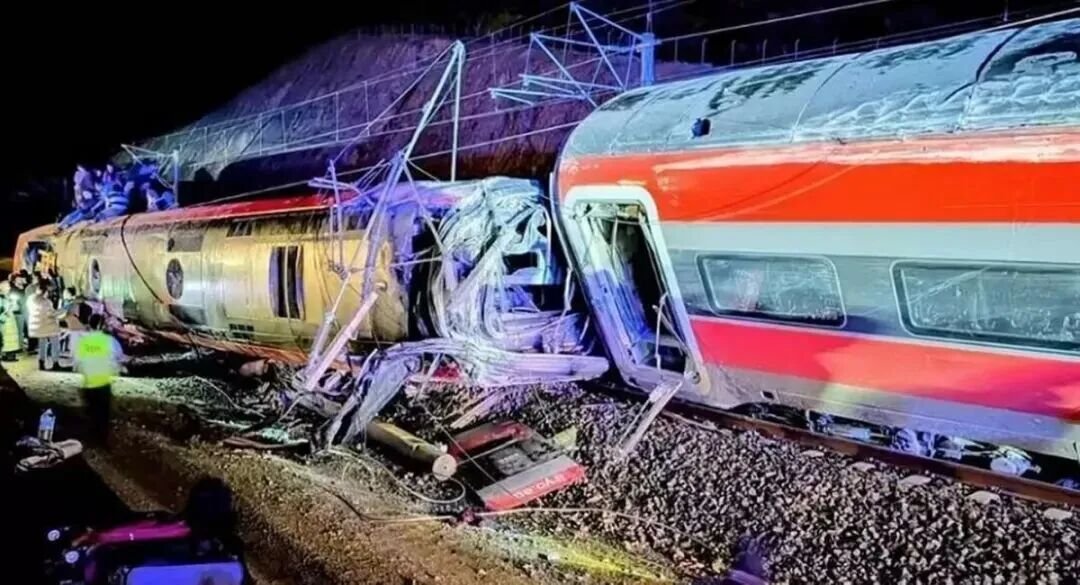
The Fatal 20 Seconds: A Second Impact After Derailment
The accident happened around 7:40 PM local time on January 18. An Iryo high-speed train traveling from Seville to Madrid first derailed, with its carriages obstructing the track. Just about 20 seconds later, an oncoming Alvia train, unable to stop in time, directly struck the derailed carriages. The tremendous impact threw two of the Alvia train’s cars off the track, causing them to roll down a 4-meter-high embankment. The train cars were severely twisted and deformed, leaving the scene in chaos.
Casualties and Rescue: 48 Hospitalized, DNA Samples to Confirm Identities
According to official data as of noon on January 19, the accident has resulted in 39 deaths, with another 39 people missing. The total number of injured reached 152, with 48 still receiving treatment in hospitals. Twelve are in serious condition and have been admitted to the Intensive Care Unit (ICU), including a critically ill child. Due to the severe damage to some carriages, identifying the victims and the missing is extremely difficult. To expedite the process, police have set up a special DNA sampling office near the accident site to help confirm the status of the missing persons. Over 200 members of the Civil Guard, rescue teams, and teams of psychologists are in Córdoba and at Madrid’s Atocha train station to provide support and assistance to anxious families.
Accident Investigation: Focus on Infrastructure Safety Hazards
Álvaro Fernández Heredia, the president of Adif (Spain’s railway infrastructure manager), revealed that the section of the track where the accident occurred had just undergone a major overhaul in May 2025 and was fully equipped with the advanced LZB automatic train control system. This has led investigators to initially rule out the possibility of speeding or human error. Currently, the accident investigation committee, led by the Spanish Ministry of Transport, has officially begun its work. The investigation is leaning towards material fatigue failure of the rolling stock or, more likely, an undetected flaw in the railway infrastructure. Reports indicate that a union had previously issued warnings about safety hazards on this particular track section, making infrastructure issues a primary focus of the investigation. The official investigation report is expected to take several weeks to complete.
Nationwide Impact: Southern High-Speed Network Completely Halted
Affected by this catastrophic accident, Spain’s national railway company (Renfe) announced on January 19 that all high-speed services (AVE) between Madrid and the Andalusia region—including routes to major cities like Córdoba, Seville, Málaga, and Huelva—will be suspended “until further notice.” On the 19th alone, 111 trains were canceled. This decision has affected the travel plans of tens of thousands of passengers. Renfe is offering free refunds or ticket changes to all affected passengers and advises those with non-essential travel plans to consider other road transport options. To alleviate the backlog of passengers, Iberia Airlines has urgently added extra flights as a supplementary transport capacity.
