Surge in Foreign Workers Fills Labor Shortage
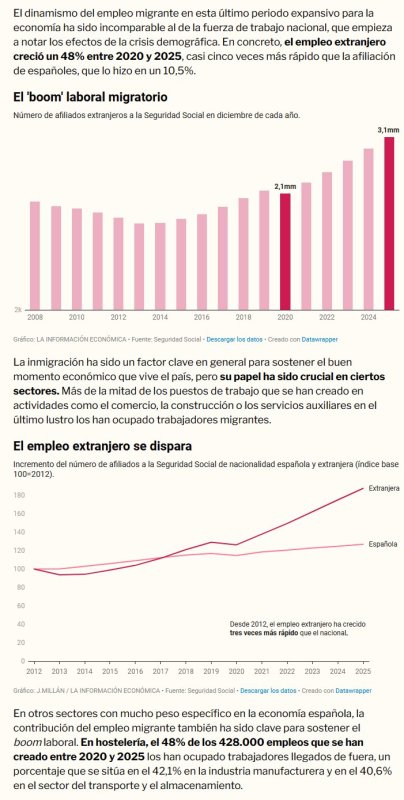
According to the latest statistics from Spain’s Social Security department, the employment of foreign workers has seen an explosive growth of 48% over the past five years, while the increase for native workers was merely 10.5%. This disparity highlights that foreign labor has become the main engine of growth in Spain’s labor market. In the last year alone, 204,659 new foreign individuals joined the social security system, accounting for 40% of the year’s new job positions. Overall, between 2020 and 2025, over a third of new jobs in Spain were taken by foreigners, totaling nearly 1 million, reflecting the country’s use of immigration to address labor shortages.
Uneven Industry Distribution with Heavy Reliance on Traditional Services
The distribution of immigrant labor across Spanish industries is markedly uneven. In sectors like commerce, construction, and auxiliary services, over half of the new positions were filled by foreign workers. The hospitality industry (48%), manufacturing (42.1%), and transport and storage (40.6%) also rely heavily on immigrants. In contrast, the proportion of immigrants is lower in the public sector and high-value-added industries. For instance, in the health and social services sector, only 16% of new roles were taken by immigrants; this figure is 5.4% in education and as low as 3.1% in public administration. This indicates that immigrant labor is primarily concentrated in labor-intensive and basic service industries.
Latin America Becomes the Main Source of Labor
Linguistic and cultural proximity makes Latin America the primary source of foreign labor for Spain. Between 2020 and 2025, nearly half of the new foreign workers came from this region. Colombia leads with 166,433 new workers, closely followed by Venezuela (132,830). Additionally, workers from Peru, Argentina, Honduras, and Cuba have also increased significantly. Among non-Latin American countries, Morocco is the largest contributor, with 111,378 new jobs. Among European countries, Italy (82,131) and Ukraine (32,255), with many seeking refuge from conflict, have also become important sources of labor.
The Dual Challenge of Economic Opportunity and Social Integration
The Spanish government has repeatedly emphasized that attracting foreign labor is crucial for sustaining the economic recovery and safeguarding the public pension system. Prime Minister Pedro Sánchez has clearly stated that the country needs to remain open to promote prosperity and social cohesion. However, the rapid expansion of the immigrant population has also sparked concerns among parts of the public. According to a poll by the Spanish Centre for Sociological Research (CIS), 16% of respondents view immigration as one of the country’s main issues. How to meet economic development needs while promoting social integration and balancing public sentiment has become a core challenge for the Spanish government’s immigration policy.
