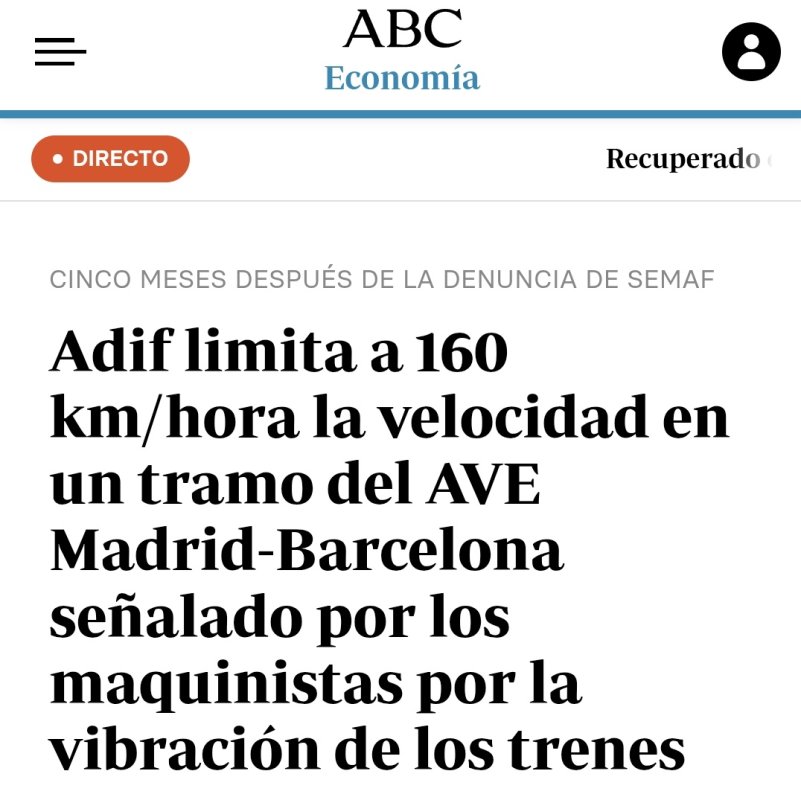
Spain’s national railway infrastructure manager (Adif) confirmed this Tuesday that it has implemented a temporary speed limit on a section of the Madrid-Barcelona high-speed line, with maximum speeds not to exceed 160 km/h. This decision is a precautionary measure taken for safety reasons after several train drivers reported track anomalies.
Reason and Scope of the Speed Limit
According to Adif’s explanation, the speed limit is based on reports from several drivers who felt “vibrations” on the track while traveling between Mejorada del Campo in Madrid and Alhama de Aragón in Zaragoza. To comply with established safety protocols, Adif decided to take action. The affected section totals approximately 150 km, nearly a quarter of the entire line’s length. Specifically, it involves 148.1 km of the double-track line and a tunnel at kilometer point 187 on a single-track section near Ariza, Zaragoza.
Accident Context and Union Warnings
The timing of this speed limit is particularly sensitive, coming just two days after a major train accident in Adamuz, Córdoba, which resulted in 42 deaths and over 150 injuries. The Spanish train drivers’ union revealed that the track vibration issue is not new; they had issued multiple warnings to the management in previous months, which were not given sufficient attention. This casts a shadow over the “temporary” nature of the current measure.
Political Reaction and Public Scrutiny
Once announced, the speed limit order immediately caused political ripples in Spain. The opposition People’s Party (PP), through its Deputy Secretary for Economic Affairs, Juan Bravo, demanded an urgent explanation from the government. He pointed out that this measure contradicts earlier statements by the Minister of Transport, Óscar Puente, who had promised to increase the line’s speed to 350 km/h. The Podemos party also called for a detailed explanation from the government to avoid a further crisis of public confidence in the railway system, especially in the context of the recent serious accident.
Subsequent Actions and Travel Impact
Adif has stated that maintenance teams are scheduled to conduct a comprehensive inspection of the relevant sections overnight to assess the track’s condition. This will determine whether to extend the speed limit or, once safety is confirmed, restore the original maximum operating speed of 300 km/h. Although officials have not yet announced specific delay times, the significant speed reduction is expected to lengthen the travel time for trains between Madrid and Barcelona.
