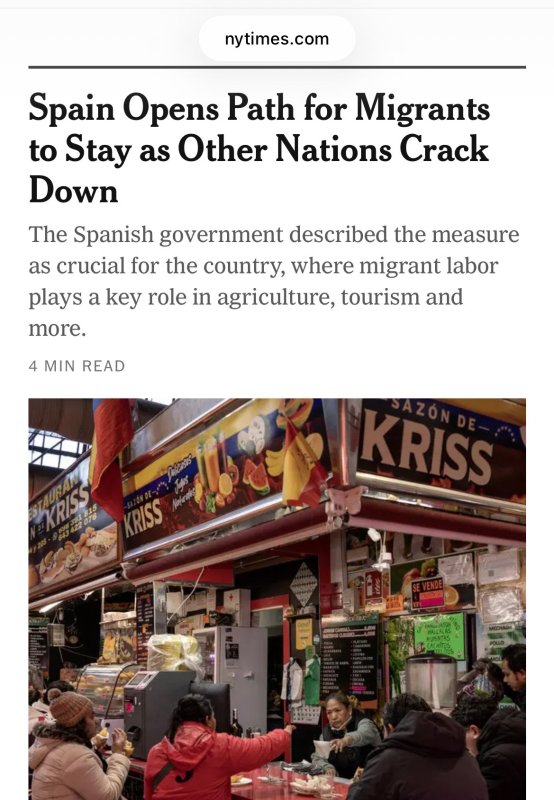
The Spanish government approved a landmark reform of its Immigration Law on January 27, 2026, initiating the largest-scale regularization process for undocumented immigrants since 2005. This policy, passed directly by the Council of Ministers as a Royal Decree-Law, bypassed parliamentary debate, aiming to provide a pathway to legal status for hundreds of thousands of undocumented immigrants within the country.
Extremely Lenient Application Requirements
Under the new rules, any undocumented immigrant who can prove they have resided continuously in Spain for five months by December 31, 2025, is eligible to apply for residency. While applicants are required to have ‘no relevant criminal record,’ the new law significantly relaxes the requirements for proving residency. The previously strict reliance on an official certificate of registration (padrón) can now be substituted with various unofficial documents, such as rental agreements, bank transfer records, medical appointment slips, or even public transport tickets.
Strong Opposition from Law Enforcement
Although the policy is viewed as a humanitarian gesture, it immediately drew collective criticism from Spain’s main police unions (including SUP, Jupol, and CEP). The police organizations warned that such a large-scale and low-threshold amnesty could create a significant ‘pull effect’ (efecto llamada), encouraging more illegal immigration to Spain. More critically, they pointed out that due to inefficiencies in the Spanish judicial system, many suspects in serious crimes may still appear to have a ‘clean’ record, creating a huge security loophole in the ‘no criminal record’ requirement.
Application Process and Future Impact
The decree will take effect immediately upon its publication in the Official State Gazette (BOE), with the application window open until June 30, 2026. Once an immigrant’s application is processed, any deportation proceedings against them will be automatically suspended. The applicant will then receive a temporary permit allowing them to legally work and access healthcare in Spain. According to official estimates, this amnesty will benefit over 500,000 of the approximately 840,000 undocumented immigrants nationwide. However, the long-term social consequences of this policy, which seeks a balance between humanitarianism and social order, remain to be seen.
