Forging Official Notices to Create a False Sense of Urgency
Scammers, posing as the Spanish General Directorate of Traffic (DGT), are sending emails to users claiming they have an outstanding traffic violation fine. These emails are meticulously designed, mimicking the tone and format of official documents, making them highly deceptive. To compel users to act quickly, the content often includes threatening language, such as, “if not paid within 24 hours, the fine will automatically double to 400 euros,” creating a strong sense of urgency to lower the recipient’s guard.
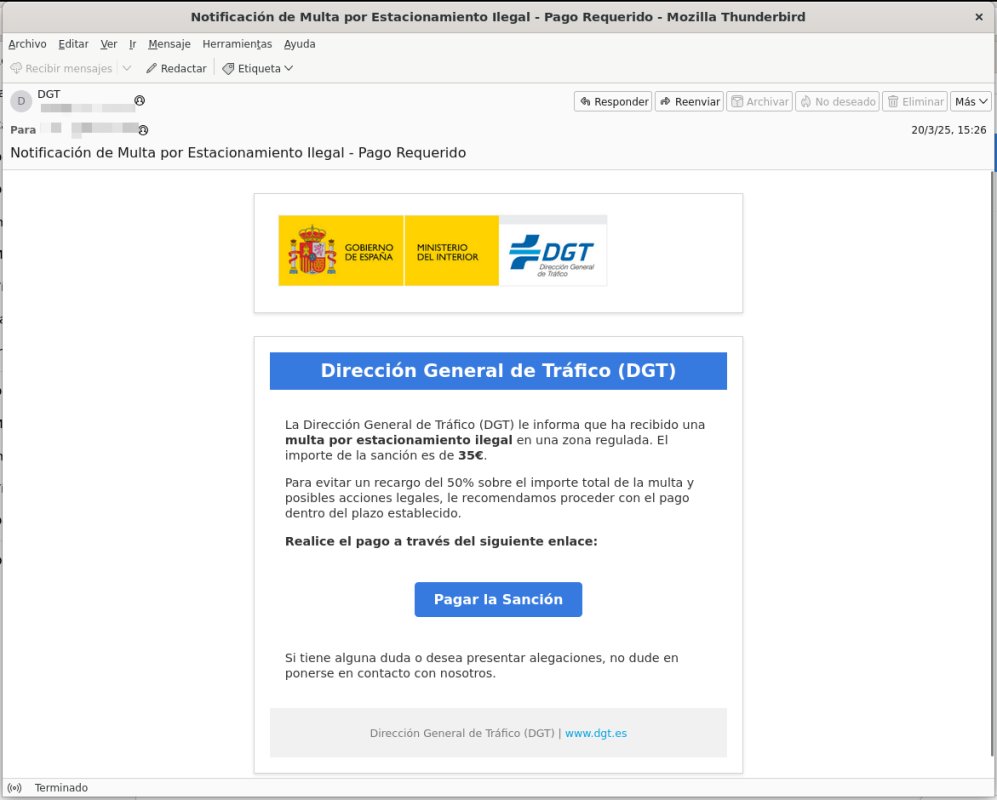
Key Clues for Identifying Scam Emails
Although these phishing emails are highly realistic, there are still telltale signs. First, the sender’s email address is usually unrelated to the DGT’s official domain (dgt.es), which is a clear red flag. Second, the body of the email will contain one or more hyperlinks directing the user to click. These links redirect victims to a convincing but fake DGT website, with the ultimate goal of stealing the personal identity information and bank card details that users enter on the site, thereby stealing their funds.
Official Statement from the Authorities
In response to such fraudulent activities, the Spanish General Directorate of Traffic (DGT) has repeatedly clarified through official channels that it absolutely does not send fine notifications to the public via email or SMS. All formal notifications regarding fines are delivered through more traditional and secure methods, such as registered mail. Concurrently, the Spanish National Cybersecurity Institute (INCIBE) has also issued related warnings, pointing out that this is a typical phishing attack aimed at illegally obtaining citizens’ sensitive data.
Safety Precautions and Emergency Measures
Official security agencies advise that anyone who receives such suspicious emails or text messages should adhere to the principle of “do not click, do not reply, and do not provide information,” and delete the email immediately. If you have inadvertently clicked on a link and submitted personal or banking information, you must take immediate remedial action: first, quickly contact your bank to explain the situation and freeze the potentially compromised bank card; second, properly save all relevant evidence, such as email screenshots and fake URLs; finally, report the incident to the local police or a cybercrime reporting center as soon as possible.
