New Spanish Minimum Wage Standard for 2026
According to the plan announced by the Spanish government in early 2026, the country’s Minimum Interprofessional Wage (SMI) will see a new increase. The new standard is set at 14 payments of €1221 per year. For unified comparison within the EU, this standard is commonly converted to a 12-payment system, resulting in a gross monthly wage of €1424.50. This increase, driven by Spain’s left-wing political forces, is planned to be retroactively effective from January 1, 2026.
Overview of EU Wage Tiers
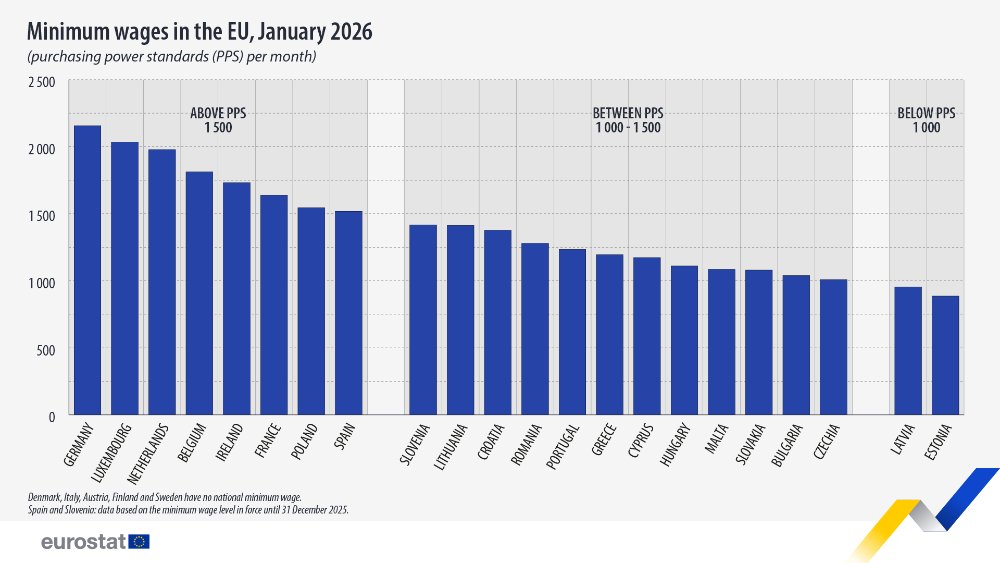
Eurostat categorizes member states into roughly four tiers based on their monthly minimum wage. The first tier includes countries with a monthly wage exceeding €2000, such as Luxembourg (€2704), Ireland (€2391), Germany (€2343), the Netherlands (€2295), and Belgium (€2112), which lead significantly in wage levels. The second tier consists solely of France (€1823), with a monthly wage between €1500 and €1999, acting as a bridge between the high-wage and medium-wage nations.
Spain’s Specific Ranking within the EU
With a minimum wage of €1424 per month, Spain ranks first in the EU’s third tier (€1000 to €1499). This tier also includes Slovenia (€1278), Lithuania (€1153), Poland (€1139), Cyprus (€1088), Portugal (€1073), Croatia (€1050), and Greece (€1027). In recent years, some traditionally ‘low-wage’ countries have seen significant wage growth and are catching up. The number of countries in the fourth tier, with monthly wages below €1000, has substantially decreased, now mainly comprising Malta, the Czech Republic, Slovakia, Estonia, Hungary, and Bulgaria, which has the lowest wage level (€620).
Labor Disputes Behind the Wage Hike
Although the wage increase is a positive sign for workers, it has sparked intense labor disputes within Spain. The Spanish Confederation of Employers’ Organizations (CEOE) has strongly opposed the plan. They argue that the 3.1% increase, combined with a provision that prohibits companies from offsetting or absorbing the rising wage costs through bonuses, will place a heavy burden on small and medium-sized enterprises (SMEs) and vulnerable sectors like agriculture. The organization warns that because these costs are difficult to pass on, the measure could lead to financial difficulties or even closures for some businesses, ultimately having a negative impact on the job market.
