Spain’s economy is becoming increasingly dependent on its foreign workforce. According to data from the Labor Force Survey by Spain’s National Statistics Institute (INE), foreign nationals have been the main drivers of job market growth in the post-pandemic era, with their influence expanding from traditional economic hubs like Madrid and Barcelona to the entire country.
Immigrants Fueling Over Half of Job Growth
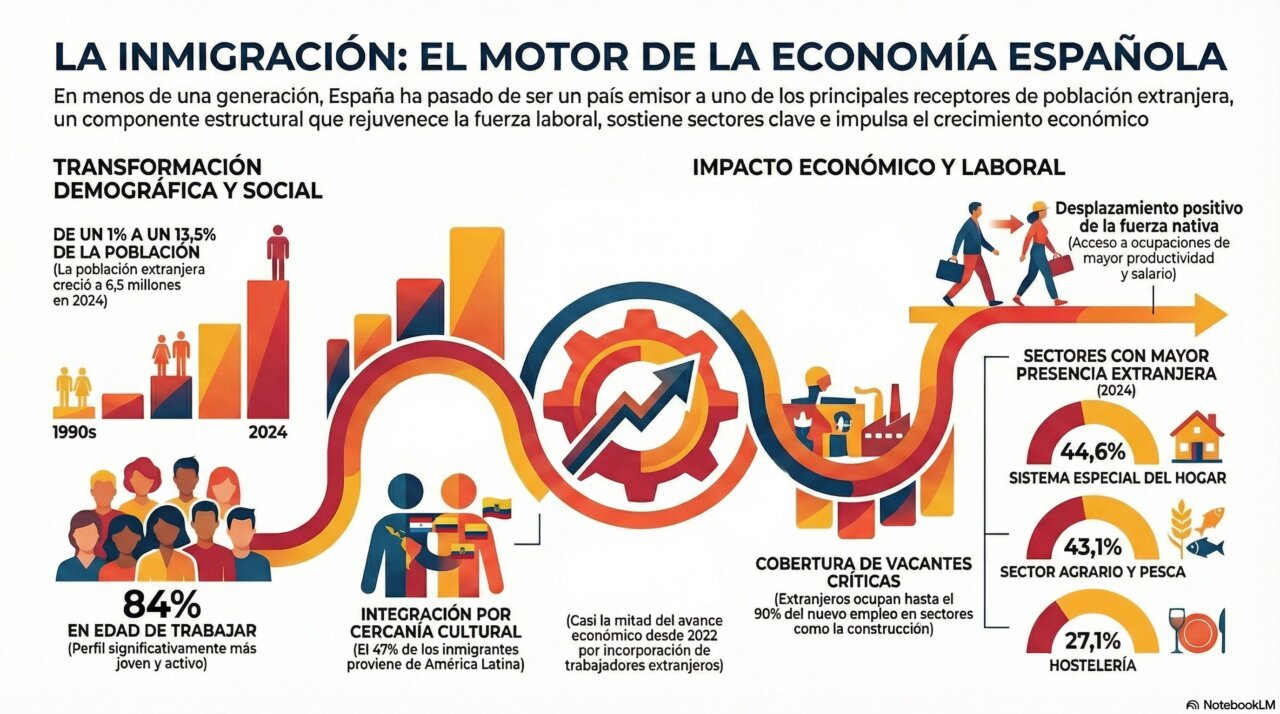
Nationally, foreign workers have filled more than half of the new jobs created in the past four years. In the current economic cycle (with data updated to the fourth quarter of 2025), foreign nationals have contributed over one million jobs, accounting for 49% of all new positions. This trend is also directly reflected in the macroeconomic landscape; a Spanish economic research institute estimates that immigrants contributed as much as 47% to Spain’s national GDP growth between 2022 and 2025.
Significant Regional Differences in Dependency
The contribution of immigrants to the job market varies significantly across different autonomous communities. Between 2021 and 2025, immigrants accounted for over 50% of new jobs in nine autonomous communities. Notably, in the Basque Country, around 90% of the 31,200 new positions were created by immigrants. This figure was 80% in La Rioja, and over 77% in Aragon and Melilla. Furthermore, in Valencia (65%), Castile and León (64%), Madrid, and Cantabria, more than half of the new jobs also came from foreign nationals.
Facing a Labor Shortage in the Millions Over the Next Decade
An aging population is a long-term challenge for Spain’s labor market. A report from the Barcelona Institute for Economic and Social Research indicates that without a sufficient influx of working-age immigrants over the next ten years, Spain will face a labor shortage of up to 1.4 million people. The demand in certain sectors is particularly urgent. For instance, the transport industry is facing hiring pressure as a large number of drivers approach retirement age. Meanwhile, the construction industry, under the dual impact of a sector recovery and the aging of the first generation of immigrant workers, is projected to need as many as 500,000 new workers to fill the gap.
