In 2026, the Spanish government and major trade unions reached an agreement to officially raise the Minimum Interprofessional Wage (SMI) to 1,221 euros per month. However, this policy, aimed at improving the living standards of vulnerable workers, has unexpectedly triggered a “pay cut” phenomenon during its implementation due to the personal income tax mechanism.
The “Pay Cut” Paradox Triggered by Progressive Taxation
According to the newly implemented salary standards for 2026, the minimum wage for full-time workers in Spain is set at 1,221 euros per month (paid in 14 annual installments). Despite the increase in base salary on paper, some entry-level workers have found their actual purchasing power shrinking. Take Abril, a 19-year-old waitress in the hospitality industry, as an example. Assuming her working hours and workload are completely identical to the previous year, her monthly net income has surprisingly decreased by 50 euros. This counterintuitive situation is not due to corporate non-compliance, but rather because the increase in gross salary has triggered a higher bracket for personal income tax withholding.
Soaring Withholding Taxes Wipe Out the Pay Raise Bonus
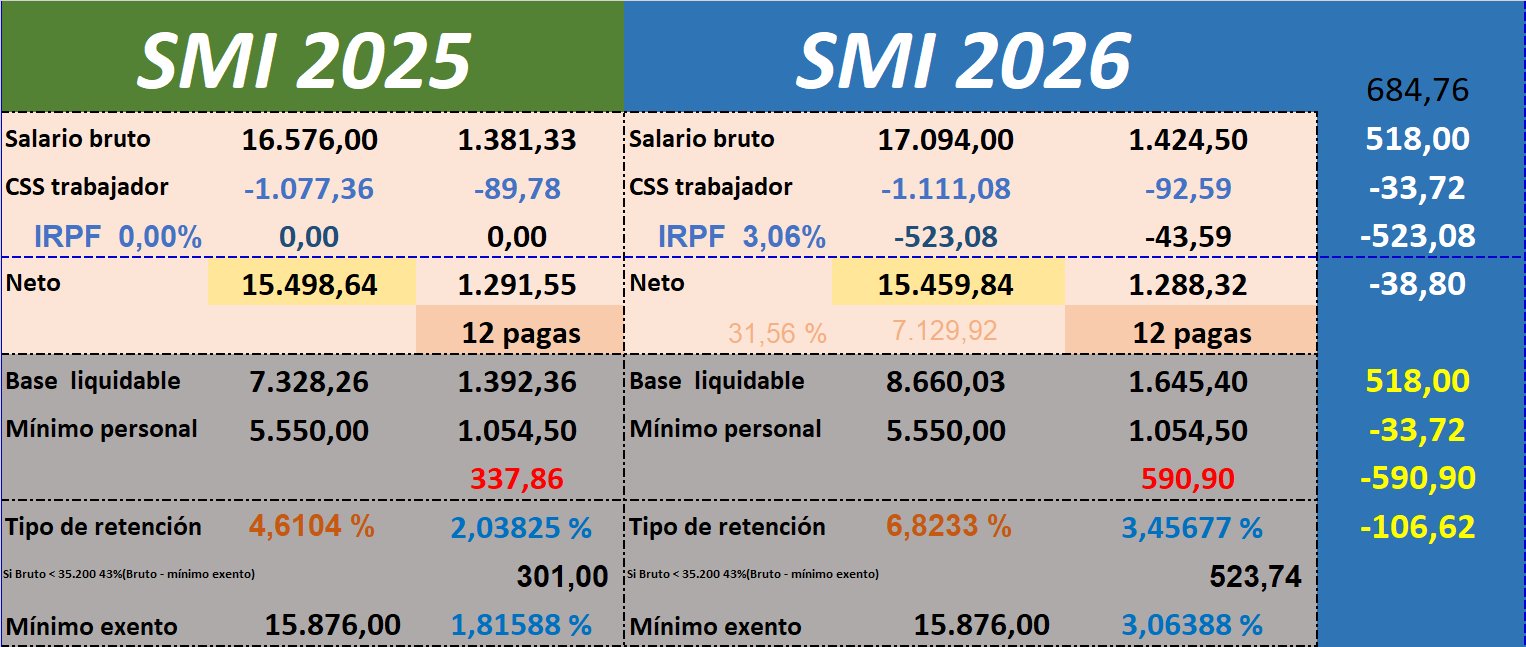
The payroll details clearly reveal the root of this contradiction. In the previous fiscal year, the employee’s gross monthly income was 1,620 euros, subject to a lower minimum withholding tax rate of 2% to 4%, resulting in a net monthly income of approximately 1,428 euros. With the overall increase in base pay, her gross monthly income for the current year rose to 1,740 euros. However, under the progressive mechanism of the Personal Income Tax (IRPF), this slight increase directly pushed her withholding tax rate up to 11%, causing her final net take-home pay to shrink to 1,358 euros. In the hospitality and catering industries, characterized by high turnover rates and generally low initial withholding taxes, the impact of such tax discrepancies is particularly pronounced.
Policy Buffer Blind Spots Exacerbate Cash Flow Pressures for Low-Income Earners
To address potential tax friction, the Spanish administration previously introduced complementary regulations exempting workers whose income exactly meets the minimum wage standard from withholding taxes, ensuring they receive their full salary. However, for employees earning slightly above this strict threshold, this protective measure automatically expires. Although the excess withheld tax is not permanently lost—workers can claim a tax refund during the annual tax return filed the following year—the 12-month waiting period severely undermines the immediate purchasing power of low-income groups. Especially against the backdrop of inflation with continuously rising rents and basic food prices, young demographics lacking formal rental contracts to offset taxes are facing increasingly severe daily cash flow dilemmas.
