According to the latest data released by Eurostat, overall inflation in Europe was further contained at the beginning of 2026, though the divergence in price trends among member states has become increasingly pronounced.
Eurozone Inflation Hits Recent Low
In January 2026, overall price pressures in the Eurozone showed clear signs of easing. Data reveals that the Eurozone’s annualized inflation rate dropped from 2% in the previous month to 1.7%. This figure not only successfully falls below the European Central Bank (ECB) medium-term inflation target of 2% but also marks the smallest year-on-year increase since September 2024. Meanwhile, the broader European Union’s overall inflation rate also narrowed from 2.3% to 2%, indicating a stabilizing macroeconomic environment.
Spain’s Inflation Slowdown Lags, Remaining High Among Major Economies
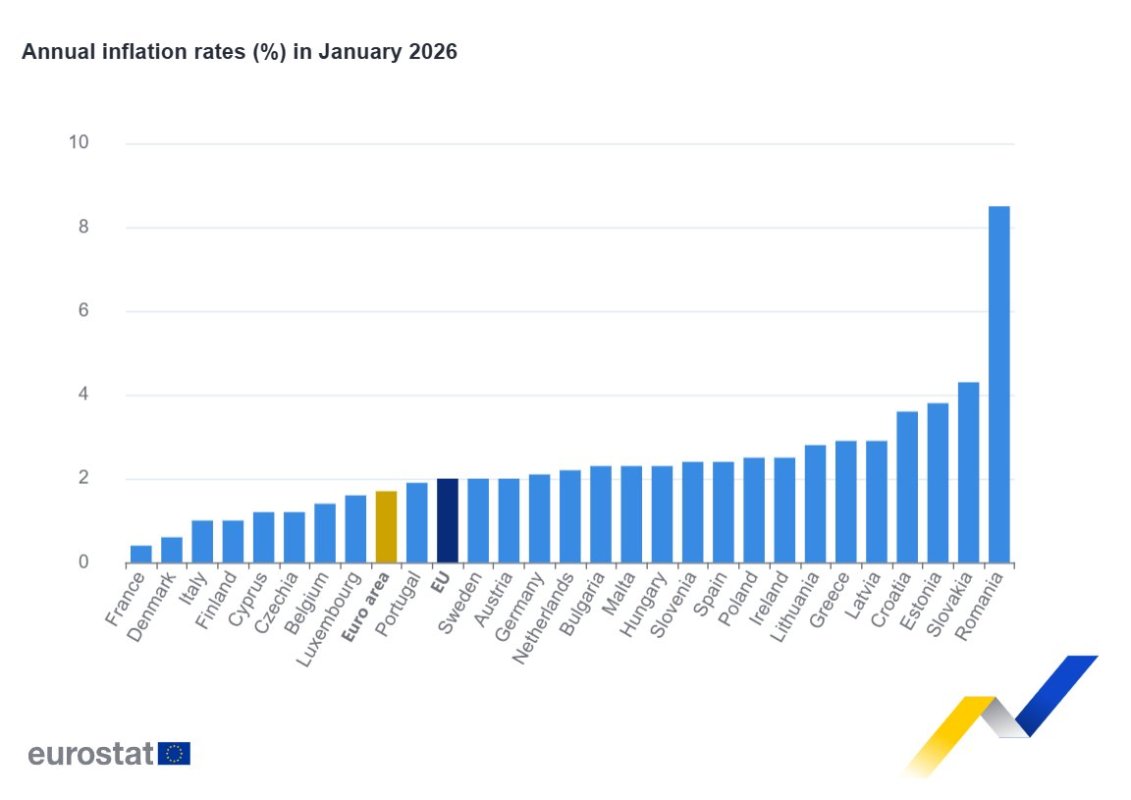
Despite the broader cooling trend across Europe, Spain’s inflation has remained relatively ‘stubborn’. In January, Spain’s annual inflation rate saw only a slight decrease from 3% in the previous month to 2.4%. This decline not only lags behind the Eurozone average but also stands out among major European economies. By comparison, Germany’s inflation rate in January was 2.1%, Italy’s dropped to 1%, and France’s plummeted to 0.4%.
Currently, Spain’s price growth is about 0.7 percentage points higher than the EU average, tying with Slovenia (2.4%) in the upper-middle range. Across the entire EU, France and Denmark (0.6%) achieved the best performance in inflation control, while Romania (8.5%) and Slovakia (4.3%) are facing the most severe price pressures.
Energy Price Drops Drive Continuous Improvement in Core Inflation
Regarding the structural changes in the inflation data, Eurostat’s analysis points out that a sharp decline in energy prices is the core driving force behind this overall downward trend in inflation. In January, EU energy prices fell by 4.1% year-on-year. In contrast, prices in certain essential livelihood sectors remain firm; fresh food prices rose by 4.2% year-on-year, while service sector costs and non-energy industrial goods prices recorded year-on-year increases of 3.2% and 0.4%, respectively.
It is worth noting that the core inflation rate, which excludes volatile energy, food, alcohol, and tobacco prices, also showed positive signals. This core indicator successfully fell to 2.2% in January, reaching its lowest level since October 2021. This indicates that the underlying long-term upward price pressure in the Eurozone is substantially weakening.
