Spain Leads EU Job Growth, Contributing Over Half of New Positions in 2025
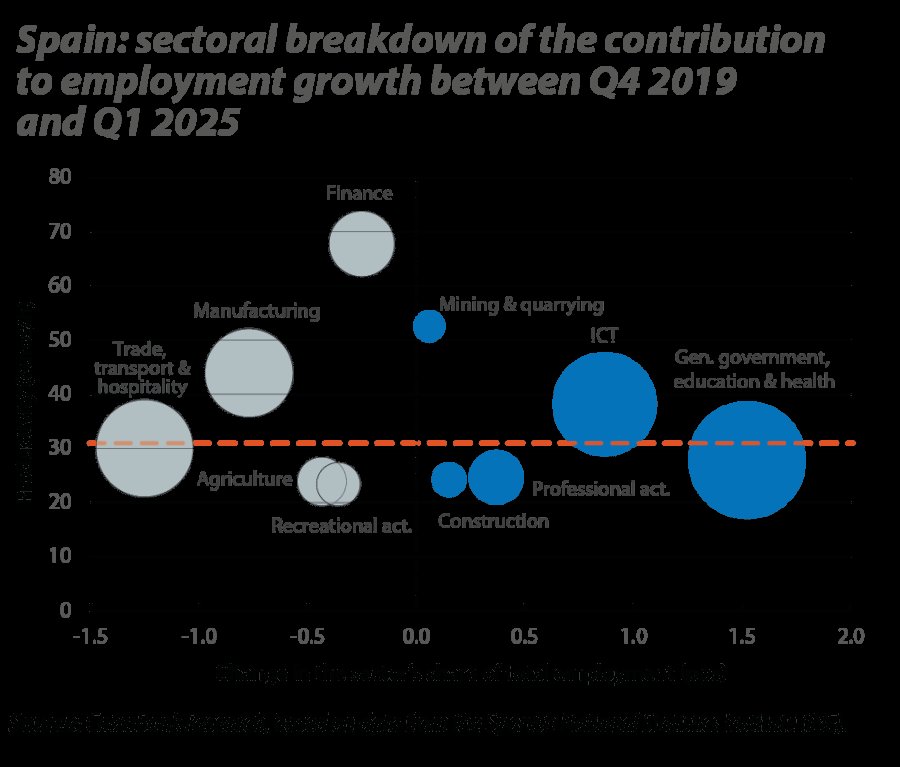
According to the latest data from the European Union’s statistical office (Eurostat), Spain is showing exceptional performance in job growth for 2025, becoming a core force driving the entire EU job market forward. The data reveals that Spain will add approximately 603,600 new jobs that year, which represents 55% of the EU’s total new positions (around 1.1 million). This contribution rate is the highest for Spain in nearly two decades, highlighting its key role in the current European economic landscape.
Polarization in the EU Labor Market
Although Spain’s performance is strong, the overall pace of job growth in the EU is slowing. The approximately 1.1 million new jobs in the EU for 2025 represent the lowest annual increase since 2020, a decrease of about 627,000 from the previous year. The market shows a clear polarization:
- Growth Areas: Job growth is primarily concentrated in Southern European countries. In addition to Spain, Italy will add about 290,500 jobs, and Portugal will add around 121,700. Furthermore, Bulgaria, Czechia, Ireland, Greece, Denmark, France, and Croatia also achieved varying degrees of growth.
- Declining Areas: Some member states are facing employment contraction. Notably, Romania’s job positions decreased by approximately 298,200, making it the country with the largest decline. Germany, Sweden, Finland, and Lithuania also experienced a drop in employment numbers.
Long-Term Trends and Historical Context
From a longer-term perspective, Spain has been the EU’s top job creator since 2019. During this period, its number of employed people increased by approximately 2.14 million, a growth of 10.4%, ranking first among the EU’s major economies. However, in terms of growth rate, smaller economies like Malta (30.2%) and Ireland (20.4%) showed more outstanding performance.
The last time Spain made such a significant contribution to EU employment was back in 2004. At that time, a growth model driven by a booming construction sector led Spain to contribute about three-quarters of the EU’s new jobs. However, that model also planted the seeds for the subsequent real estate bubble burst and financial crisis, which led to Spain becoming one of the countries with the most severe unemployment problems. This historical background provides an important reference for assessing the sustainability of the current job growth.
Wage Challenges Amid Job Growth
While the number of jobs is increasing significantly, wage growth in Spain is facing pressure. Projections indicate that the average wage growth rate in Spain for 2025 will be only 3.2%, which would be the lowest rate since the COVID-19 pandemic. This data suggests that the labor market’s recovery has not yet fully translated into strong income growth for residents. How to ensure reasonable increases in workers’ compensation while expanding employment will be a challenge Spain needs to address in the future.
