Private Label Penetration Leads the EU
As inflationary pressures are passed on to consumers, the shopping baskets of the Spanish public have undergone a significant transformation. A recent study by the consulting firm Simon-Kucher reveals that 57% of Spanish consumers now choose supermarket private labels as their primary or almost exclusive option. This percentage is not only higher than the EU average of 50% but also surpasses major economies like France, the UK, and Germany.
The report highlights that the rising cost of living is the core driver behind this trend. 51% of surveyed consumers plan to further increase their purchases of private label products in the future. More notably, even if prices stabilize, a staggering 84% of consumers state they would not reduce their spending on these goods, indicating a long-term shift in their consumption habits.
Category Performance Varies, with Household and Food Items Being Most Popular
The popularity of private label products differs across various categories. Data shows their highest penetration is in household cleaning products, reaching 57%. This is followed by canned goods and nuts (41%), and breakfast and bakery products (40%). Additionally, Spanish consumers’ preference for private label snacks (36%) is also significantly higher than the international average.
However, in areas that rely heavily on brand reputation, such as alcoholic beverages and baby products, the market share of private labels remains relatively limited. This suggests that consumers still prefer to choose established, well-known brands for certain categories.
From a Makeshift Option to a “Smart Shopping” Mindset
Consumer choice is still correlated with income level. Among households with a monthly income below €1,000, as many as 70% of consumers primarily buy private label products. In contrast, for affluent groups with a monthly income exceeding €5,000, this figure drops to 32%.
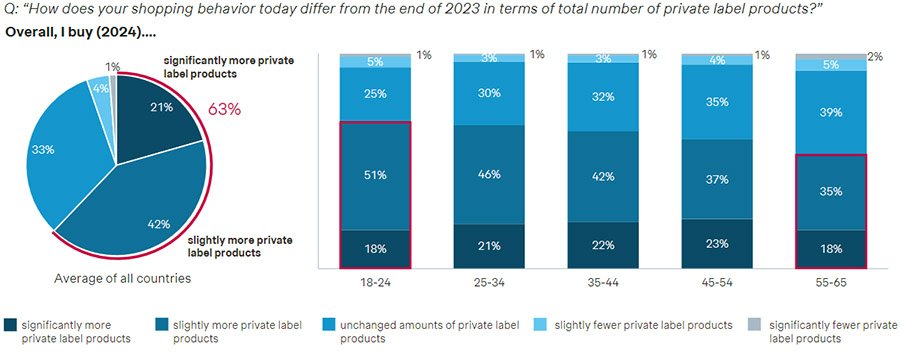
Despite this, experts believe that choosing store brands is no longer exclusive to lower-income groups. In Spanish society, “buying private label” is gradually becoming a symbol of “smart shopping” that transcends social classes and is widely accepted and recognized. This phenomenon is closely tied to the economic cycle. Whenever the economy faces downward pressure or an inflation crisis, the market share of private label products experiences a growth peak. Currently, they account for nearly 50% of the shopping basket in Spain.
Supermarkets Double Down, “Premium Private Label” Emerges as a New Trend
To adapt to market changes, major supermarket chains are actively ramping up their private label strategies. Retailers like Mercadona and Dia are constantly innovating, expanding their product lines from basic necessities to niche markets such as high-protein foods and functional drinks, aiming to enhance their competitiveness through innovation.
A noteworthy new development is the rise of “premium private labels.” The survey shows that 38% of consumers have recently increased their purchases of these high-quality store brand products, while 57% have already become regular customers. This signals that private labels are undergoing an upgrade from price competition to quality competition. The line between them and traditional brands is becoming increasingly blurred, heralding a new phase of development for the Spanish retail market.
