A ‘Special Tribute’ from Iranian Media
Recently, media outlets with close ties to Iran’s clerical regime published a series of striking images: the photo of Spanish Prime Minister Pedro Sánchez printed on a missile ready for launch. These images circulated widely on social media, accompanied by threatening text in Persian, suggesting the missile was about to be used to attack ‘occupied territories’.
Along with the photo, a previous statement by Sánchez regarding the current conflict was also shared: “This war is not only illegal, but it is also inhumane.” The Iranian side apparently interpreted this remark as support for their position and used it for further propaganda. As of now, the Spanish Prime Minister’s Office has not publicly responded to the matter.
Israel’s Sharp Response
In response to this incident, Israel reacted swiftly. The Israeli Ministry of Foreign Affairs, through its official social media platforms, directly questioned Sánchez: “How does it feel to see your face and your words on an (Iranian) missile?”
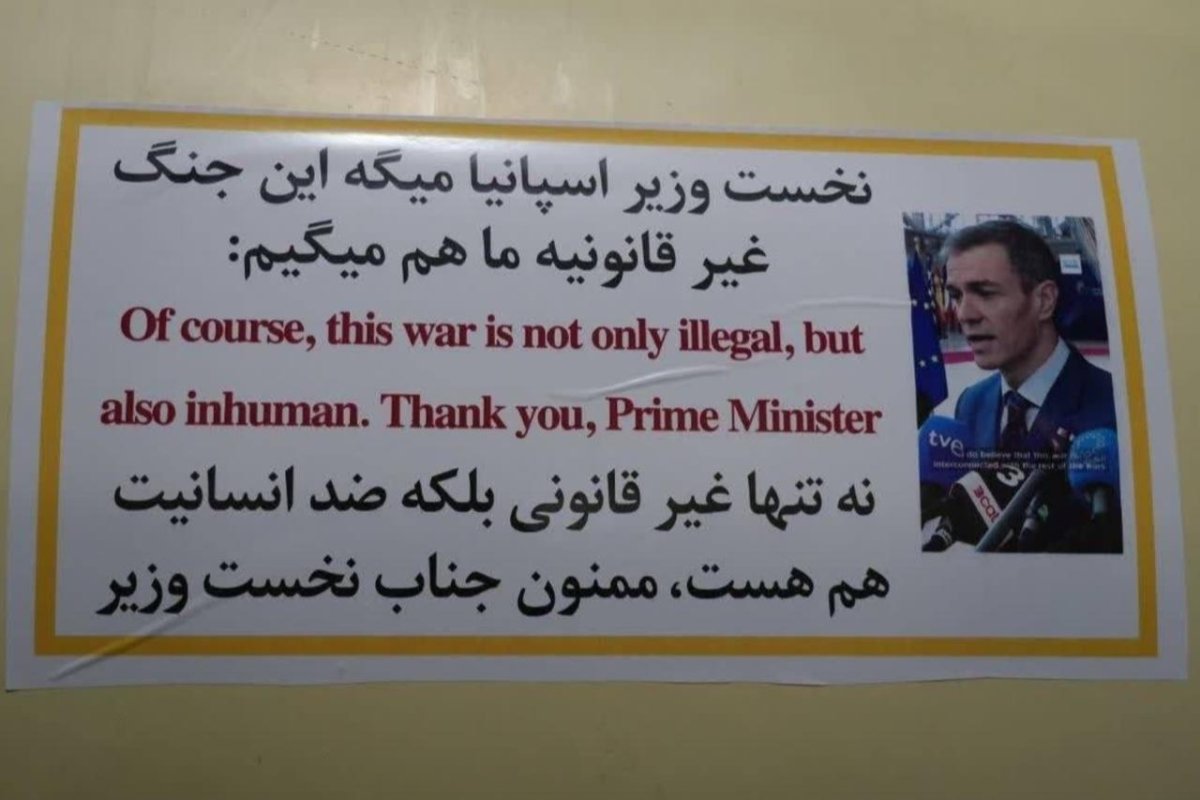
Beyond the question, Israel’s statement carried a clear warning, implying that the range of these missiles could also cover Spain. This stance undoubtedly escalated the tension, directly drawing Spain into the complex relationship involving Iran and Israel.
The Escalating Diplomatic Dispute
This is not the first time Sánchez’s stance has caused dissatisfaction from Israel. Israeli diplomats have repeatedly made sarcastic public comments, stating that Sánchez continuously receives ‘thanks’ and ‘praise’ from Hamas, the Houthis, and Iran for his position on international conflicts.
Israel has used this to question the Sánchez government’s international alignment, asking if this is what it means to be ‘on the right side of history.’ The controversy surrounding Sánchez’s statements has evolved from a single incident into scrutiny and criticism of his entire foreign policy, making Spain’s position on Middle East issues increasingly delicate.
‘Anti-War’ Stance Caught in a Whirlwind of Controversy
This incident highlights how in the current, highly complex and polarized international environment, any public statement can be interpreted, amplified, or even weaponized by different sides. The ‘anti-war’ and humanitarian stance the Sánchez government intended to express, after being ‘packaged’ by Iranian media and met with a fierce counterattack from Israel, has ultimately turned into an uncontrollable international public opinion storm.
Analysts point out that this event is a classic example of how, in polarized conflict narratives, even neutral or seemingly clear stances can struggle to remain unscathed. Once the words of political figures enter the public sphere, their meaning and impact can extend far beyond initial expectations, drawing them into a larger geopolitical game.
