Overall Employment Scale and Growth Trend
The Permanent Observatory of Immigration, under Spain’s Ministry of Inclusion, Social Security and Migration, recently published a report detailing the latest results of the arraigo residency system. The report indicates that as of December 31, 2025, the total number of employed foreign workers in Spain holding an arraigo permit and registered with the Social Security system has exceeded 214,000. This figure represents a significant 40% increase compared to the same period last year.
Data shows a continuous upward trend in employment for this group throughout 2025, steadily climbing from approximately 155,000 in the first quarter to a new historical high by the end of the year. In a related statement, the Spanish Prime Minister’s Office cited the views of Minister Elma Saiz, affirming that this growth strongly demonstrates that arraigo is a key tool for promoting effective social integration.
Analysis of Residency Types and Employment Contracts
Among all employed individuals with arraigo permits, the distribution varies by residency type. Family-based arraigo (arraigo familiar) is the main category, accounting for a 58% share, followed by social arraigo (arraigo social) at 21%.
In terms of labor security, employment stability is relatively high. Among all arraigo workers contributing to the pension system, 46% hold full-time, permanent contracts. Regarding sector distribution, the services industry absorbed the largest workforce, with 37,036 people, followed by administrative activities, construction, and commerce.
Worker Profile: Nationality, Gender, and Age
The report provides a profile of the workers. In terms of gender structure, men account for 55% and women for 45%, with the numbers for both groups showing significant growth over the past year. The average age of this workforce is 36.
The average age of workers varies by their country of origin. For example, workers from Pakistan are the youngest, with an average age of just 33, while those from Venezuela and Cuba have an average age of over 40. In the nationality distribution, Colombia is the largest country of origin, accounting for 29% of the total, followed by Morocco at 14%, and Peru in third place with 10%.
Special Groups and Regional Distribution
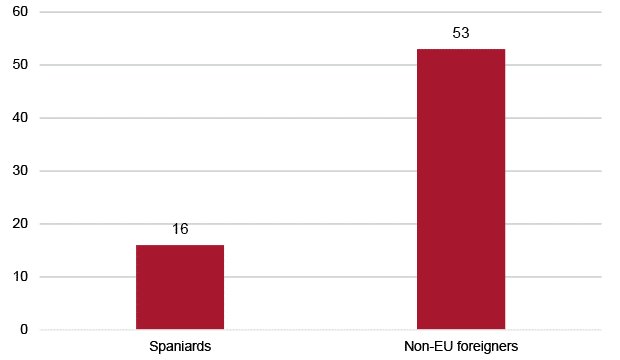
The report also pays special attention to the employment situation of young immigrants who were formerly under the guardianship of the Spanish government. By the end of 2025, a total of 20,201 such young people aged between 16 and 23 held residency permits, 59% of whom have successfully entered the labor market. Within the 18 to 23 age group, the employment rate is as high as 69%.
Overall, the total number of people in Spain with a valid arraigo residency permit has reached 394,110, accounting for 11% of the total foreign resident population. In terms of regional distribution, the two major cities of Madrid and Barcelona demonstrate strong economic appeal, concentrating 31% of all arraigo permit holders nationwide.
