Market Overview: Widespread National Price Increases
In the first quarter of 2025, the Spanish real estate market saw a significant price surge. Data from property appraisal firm Tinsa by Accumin indicates that the nominal year-on-year growth rate for new and existing home prices reached 14.3%. Even after adjusting for inflation, the real increase was a substantial 11.8%. Compared to the fourth quarter of 2024, prices grew by 3.2% quarter-on-quarter. By the end of the quarter, the national average housing price had risen to €1,987 per square meter.
Significant Regional Disparities: Madrid and Tourist Areas Lead the Surge
This round of price hikes has been widespread, but with clear regional differences. Employment hubs and popular tourist destinations have seen particularly rapid growth. Among the autonomous communities, the leaders in price increases include:
- Community of Madrid: +19.2%
- Valencian Community: +19.1%
- Castilla-La Mancha: +18.8%
- Canary Islands: +17.8%
- Cantabria: +16.2%
- Murcia: +16%
- Balearic Islands: +15.5%
At the provincial level, Toledo leads with an annual growth rate of 23.2%. Nationwide, only the province of Zamora experienced a price drop, with a decrease of 3.8%. Among provincial capitals, 30 cities saw annual growth rates exceeding 10%. Currently, the three provincial capitals with the highest prices are San Sebastián (€4,975/m²), Madrid (€4,600/m²), and Barcelona (€4,417/m²).
Worsening Affordability: Over Half of Income Spent on Housing in Some Areas
The rapid rise in housing prices has directly increased the financial burden on homebuyers. Data shows that Spain’s national “housing affordability ratio” (the percentage of household income spent on housing) averages 33.9%, which is near the recommended threshold. However, in some high-priced areas, this ratio far exceeds sustainable levels. For instance, in Madrid, residents need to allocate 49% of their household income to housing. In the Balearic Islands, this figure is even higher at 54%, meaning over half of their income is consumed by housing costs.
Comparison with Historical Peaks and Future Outlook
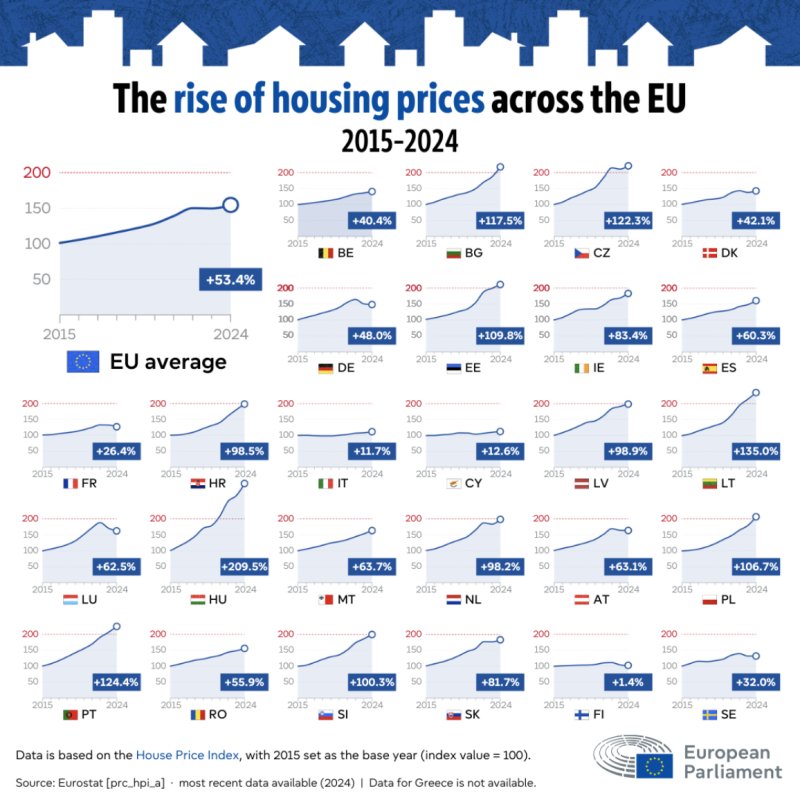
Current nominal housing prices in some regions have indeed surpassed the peak levels of the 2007 real estate bubble. These areas include the Balearic Islands, the Community of Madrid, Melilla, and the Canary Islands. However, when considering inflation, Spain’s overall real housing prices are still 34% lower than the historical high of 2007. Only the Balearic Islands have real housing prices that are very close to their historical peak (-0.1%). Since the market bottomed out and rebounded in 2015, nominal housing prices in Spain have cumulatively increased by 68%.
Looking ahead, the market continues to face multiple uncertainties. The report suggests that geopolitical conflicts in the Middle East could exacerbate inflation, thereby influencing the European Central Bank’s interest rate decisions, leading to higher mortgage costs and reduced household purchasing power. Furthermore, external instabilities could also drive up construction costs, worsening the new housing supply problem. Against a backdrop of strong demand, supply shortages, and coexisting external pressures, the heat in the Spanish property market is not expected to cool down in the short term.
