Widespread Price Hikes: From Core Cities to the Entire Country
According to the ‘Q1 2026 IMIE Local Markets Report’ published at the end of March 2026 by Tinsa, part of the Accumin group, the price of existing homes in Spain increased by 14.3% year-on-year in the first three months of the year. Even after accounting for the 3.3% inflation in March, the real increase is still a substantial 11.8%.
Data shows that the price surge has spread from major cities across the country. Among the 52 provincial capitals, 30 saw year-on-year price increases of over 10%, a significant jump from the 20 cities in the previous quarter, indicating that growth is accelerating and expanding.
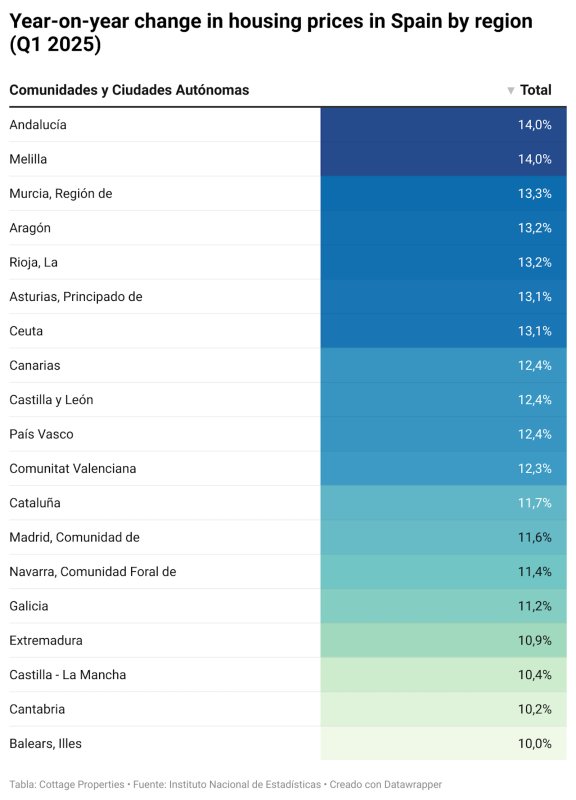
Specifically, Spanish city housing prices show a differentiated pattern:
- Cities with Extremely High Prices: The average house price in San Sebastián, Madrid, and Barcelona has surpassed €4,000 per square meter, making homeownership extremely difficult. Bilbao and Palma follow closely with an average price of €3,439/m².
- High-Growth Cities: Santander (20.9%), Albacete (20.8%), and Pontevedra (19.8%) lead with the highest year-on-year increases.
- Cities with Slowing Growth/Decline: Palencia, in the autonomous community of Castile and León, was the only provincial capital where prices fell, with a slight decrease of 1%. Huesca (1.5%), Badajoz (4.4%), and Logroño (4.7%) showed more moderate increases.
At the provincial level, Toledo (23.2%), Álava (19.6%), and Madrid (19.2%) recorded the most notable increases. Looking at autonomous communities, both the Community of Madrid and the Valencian Community saw price growth exceeding 19%.
An Affordability Crisis: Mortgage Payments Far Exceed Recommended Limits
Even more concerning than the prices themselves is housing affordability for residents. Industry experts widely agree that when a household’s monthly mortgage payment exceeds 35% of its net income, financial risk increases significantly.
However, in Spain in 2026, the housing affordability effort rate in several major cities has far surpassed this recommended limit. In Madrid and Barcelona, a household might need to allocate 60% of its income to mortgage payments. Furthermore, San Sebastián (59.2%), Palma (51.7%), and Málaga (50.3%) have also crossed the 50% threshold. According to data from the Spanish National Statistics Institute (INE) for the fourth quarter of 2025, the national average mortgage amount was €184,004, with an average monthly payment of €797.
At the provincial level, residents in the Balearic Islands (54.4%), Málaga (49.3%), and Madrid (49.1%) also face immense repayment pressure. This indicates that in some parts of Spain, buying a home has transformed from a household investment into a heavy burden that can severely impact quality of life.
Interest Rate Rebound and Deeper Market Dynamics
The intensification of pressure on homebuyers is also linked to changes in the macroeconomic environment. In March 2026, the Euro Interbank Offered Rate (Euribor), the benchmark for most variable-rate mortgages, rebounded, at one point rising to 2.551%, a new high since October 2014. This means that for borrowers whose interest rates are adjusted annually or semi-annually, their monthly payments will face a new round of increases.
The current predicament in the Spanish real estate market stems from a combination of three factors:
- Concentrated Demand: Young people flock to large cities in search of more job opportunities, leading to a surge in housing demand.
- Insufficient Supply: Limited land availability and the slow pace of new construction cannot meet market demand, creating a situation of housing scarcity.
- Rising Costs: The rebound in lending rates has directly increased financing costs for residents, further raising the barrier to homeownership.
These three factors create a vicious cycle: population inflow drives up demand, insufficient supply leads to price hikes, and rising interest rates make already expensive housing even less affordable.
A Structural Challenge: The Changing Role of Housing
Amid the current structural shifts, the nature of housing in Spain is evolving from a ‘place to live’ into a ‘barrier to social entry’. Soaring house prices and heavy mortgage burdens are systematically excluding many young people and the working class from the property market. Unable to save for a down payment or afford high monthly payments, they are forced into long-term renting.
For individuals, buying a home is no longer just a lifestyle choice but is increasingly becoming a ‘ticket’ to being able to stay in a city and integrate into a certain social class. This trend raises profound social questions: when the cost of living in a city becomes so high that talented and hardworking young people are forced to leave, the city’s vitality and future growth potential will be affected. At the same time, for the ruling party, which aims to protect the interests of young people and the working class, this poses a severe challenge ahead of the 2027 elections.
