In recent years, the path to financial independence for Spain’s younger generation has become increasingly difficult. The once primary issue of job instability has now been replaced by a worsening housing crisis, which has become the core factor delaying youth emancipation. Even with a job, the high cost of living, especially for housing, deters many young people, forcing them to postpone their plans for independent living until after the age of 30.
Dependency on Family Becomes the Norm: Youth Independence Rate Hits 21-Year Low
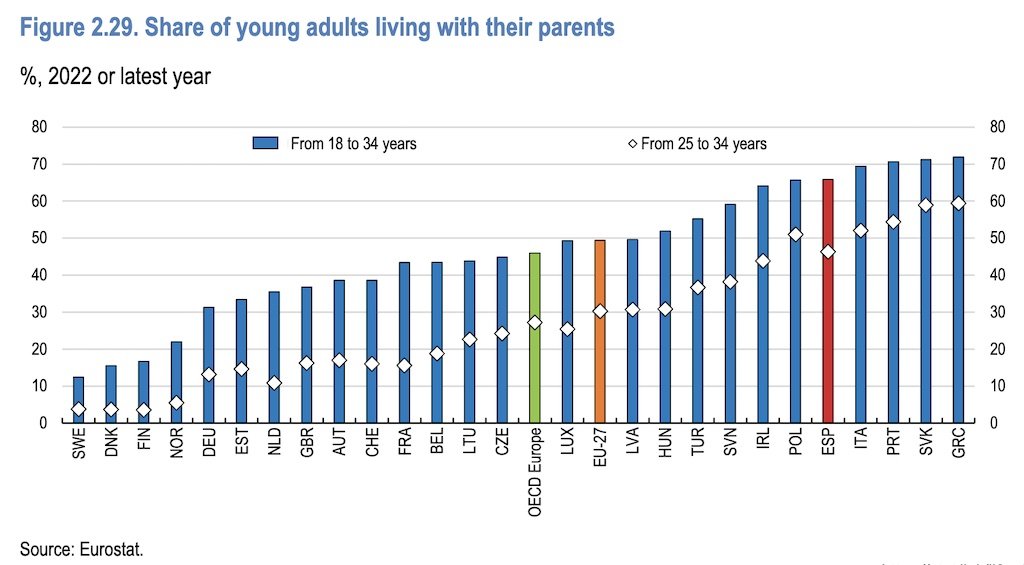
According to data from the EU Survey on Income and Living Conditions (EU-SILC), the proportion of Spaniards aged 18 to 34 living with their parents or financially dependent on their family rose to 68.7% in 2025, the highest level recorded since 2004. This means that less than a third of young people can achieve complete financial independence. Over the past 21 years, this figure has increased by a total of 17.3 percentage points, with a 1.5 percentage point rise in the last year alone.
In absolute numbers, the population of independent young people has shrunk dramatically. In 2024, only about 2.9 million young people in Spain were living independently, nearly half of the 5.5 million recorded in 2004, setting a new historical low. Within the EU, Spain’s youth dependency on family also ranks high, placing sixth in 2024—a significant drop from twelfth place a decade earlier, indicating a continuous deterioration of their relative situation.
The Decoupling of Employment and Independence: Wage Growth Fails to Match Soaring Housing Prices
A report released by the Spanish Ministry of Economy in March 2024 clearly pointed to a significant ‘decoupling’ between youth employment and financial independence. The report shows that although the youth unemployment rate has dropped to pre-financial crisis levels and wage growth has outpaced inflation, the rate of youth independence has actually declined. In 2024, only 54% of stably employed young people aged 16 to 34 were living independently, far below the 67% recorded in 2014.
The root of the problem is that rising incomes do not translate into actual housing affordability. Data shows that between 2014 and 2024, the average net salary for young Spaniards increased by 30%, but during the same period, housing prices rose by 65%, and rents surged by a staggering 82%. The high cost of housing severely erodes young people’s ability to become independent. It is estimated that over the past decade, high housing costs have suppressed the independence of 436,000 individuals, equivalent to about 311,000 potential young households that were never formed. The problem is particularly acute in regions such as Catalonia, Madrid, and Andalusia.
A Structural Crisis Beneath the Surface: Beware of ‘False Improvement’ Data
Against a backdrop of overall deterioration, some indicators of the youth situation show a ‘superficial improvement,’ masking deeper structural problems. For instance, the average age of emancipation has long remained stable at around 30. However, this isn’t because moving out has become easier, but because only a minority of young people from affluent families can achieve independence at that age, which skews the average downward.
Similarly, the decline in the youth poverty rate is also misleading. This is primarily because more and more young people are choosing to remain in their parents’ home, relying on the family’s overall income to avoid the risk of poverty. For the segment of young people already living independently, their poverty situation has not seen substantial improvement.
Analysts point out that behind these phenomena lies a growing structural conflict within Spanish society: on one hand, the generational gap is widening, with wealth and opportunities increasingly concentrated in the hands of the older generation. On the other hand, a divide is also deepening within the youth population itself, where an individual’s future prospects are increasingly constrained by their family’s economic background.
