Filing Period and Methods
The Spanish Tax Agency (Agencia Tributaria) began this year’s Personal Income Tax (IRPF) filing campaign on April 8, with a deadline of June 30. Taxpayers can file their returns through two main channels:
- Online Filing: Through the Tax Agency’s official website (sede.agenciatributaria.gob.es) or its mobile application.
- In-person Filing: Starting May 6, taxpayers can book appointments by phone to file in person at Tax Agency offices.
Personal Income Tax (IRPF) Rate Structure
Spain’s Personal Income Tax uses a progressive tax system, with annual gross income divided into several brackets. The tax structure is as follows:
- €0 to €12,450: 19% tax rate
- €12,451 to €20,200: 24% tax rate
- €60,000 to €300,000: 45% tax rate
- Over €300,000: Top marginal tax rate of 47%
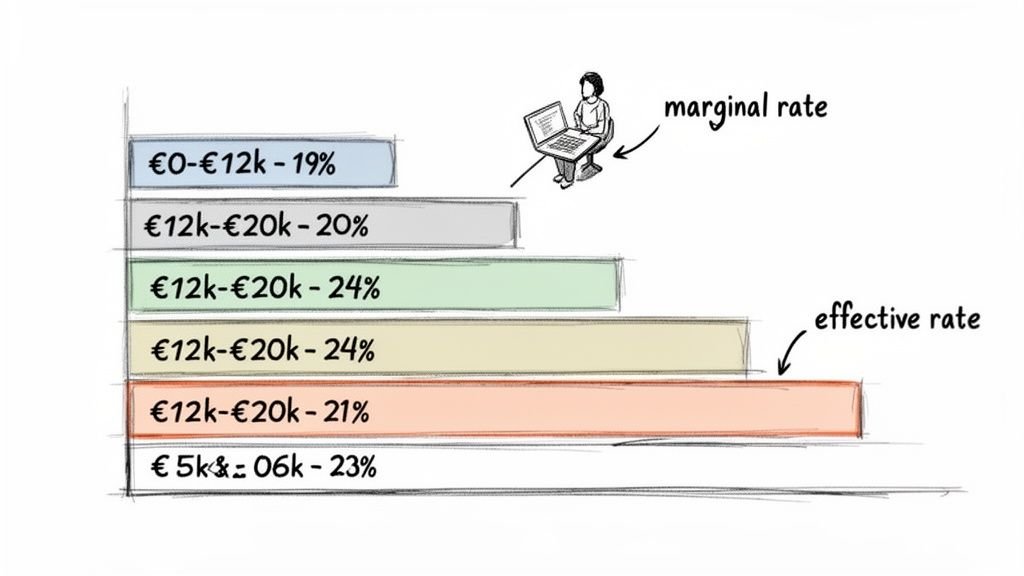
It is worth noting that the authority to collect IRPF is shared between the state and the autonomous communities. For example, using the lowest 19% tax rate, the state collects 9.5% and the autonomous community collects 9.5%. Each autonomous community has the right to adjust its portion of the tax rate. For instance, to attract residents or achieve policy goals, some communities might lower their portion from 9.5% to 9%, reducing the lowest tax rate for residents in that area to 18.5%. Conversely, for high-income earners, some autonomous communities (like Catalonia) may increase their portion of the tax rate, causing the local top marginal tax rate to exceed the national standard.
Defining the Obligation to File
Not everyone is required to file an annual tax return. Tax regulations clearly define the obligation to file:
The following groups are obligated to file:
- Individuals with multiple sources of income: Those whose total annual income from two or more payers exceeds €15,786, and the income from the second and subsequent payers combined is over €1,500.
- Recipients of specific types of income: Those with total annual earnings from movable capital, real estate (like rental income), or certain investments exceeding €1,600.
- Self-employed individuals (Autónomos): All self-employed individuals must file a return, regardless of their income level.
The following groups are exempt from the obligation to file:
- Low-income earners with a single employer: Those who earn income from only one employer throughout the year, with total earnings not exceeding €22,000.
- Minimum wage earners: Individuals with an annual income around the minimum wage (SMI), for example, €16,576 per year, are also typically exempt from filing.
- Unemployment benefit recipients: Those whose total unemployment benefits do not exceed the aforementioned income thresholds are also not required to file.
Filing Strategy for Low-Income Earners: Why Filing Voluntarily Can Be More Beneficial
Many low-income earners assume that since they are exempt from the obligation to file, they can ignore it. However, this could mean giving up a potential tax refund. The reason is that all employers in Spain are legally required to withhold a certain percentage of Personal Income Tax (Retención de IRPF) when paying salaries.
This means that even if your annual income is well below the mandatory filing threshold, you have been pre-paying taxes every month. The essence of the annual tax declaration is to settle the taxes prepaid over the past year: you either get a refund or pay the difference.
To encourage low-income groups to file and reclaim over-withheld taxes, the tax authorities have specific incentives. For example, low-income individuals earning less than €18,276 annually may be eligible for tax deductions or refunds ranging from €340 to €510 after filing.
How to Decide: To File or Not to File?
For low-income taxpayers unsure of their situation, the best approach is to:
- Use the official simulator: Access the ‘Renta Web Open Simulador’ tool provided on the Spanish Tax Agency’s website.
- Run a simulation: Enter your personal income data, and the system will calculate whether you need to pay more tax or are eligible for a refund.
- Make a decision: If the simulation results in a refund (a devolver), you should complete and submit your official return immediately. If the result is a payment due (a pagar) and you belong to an exempt group, you can choose not to submit the return.
