A reform plan in Spain aimed at granting legal status to over 500,000 undocumented immigrants has been largely finalized and is expected to be presented to the Council of Ministers for a vote as early as April 14. However, even before its formal launch, this measure—dubbed a mass “amnesty”—has already stirred a major political storm, with the government of the Community of Madrid openly vowing legal action to halt its implementation.
Core of the Reform: Apply Without a Job Contract
This large-scale regularization plan is the result of an agreement between the current Spanish government and the Podemos party, and it is planned to be implemented via a Royal Decree, thus bypassing the lengthy deliberation process in the Congress of Deputies. The draft decree has already passed review by the General Commission of Secretaries of State and Undersecretaries (CGSEYS).
According to the draft released in January by the Ministry of Inclusion, Social Security and Migration, applicants must meet three basic conditions:
- Have been in Spanish territory before December 31, 2025.
- Have resided continuously in the country for at least five months prior to submitting the application.
- Have no criminal record.
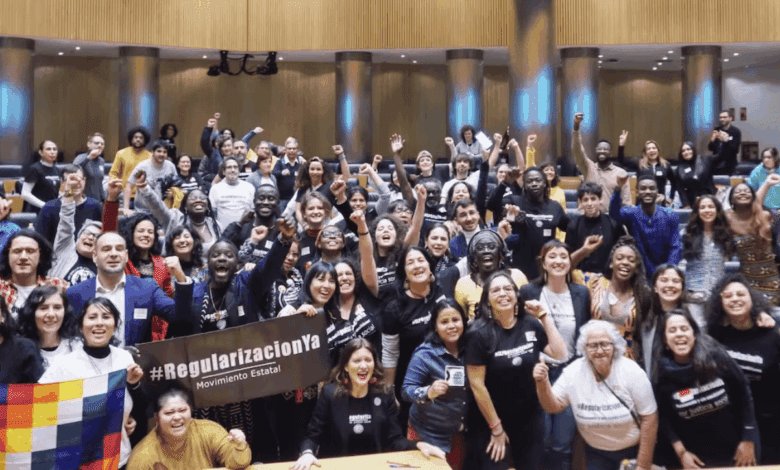
The most groundbreaking aspect of this reform is that applicants do not need to provide an employment contract to initiate the application process for an initial residence permit. This provision completely overhauls a core requirement of the current immigration regulations, aiming to open a door to regularization for hundreds of thousands of immigrants living or working in the informal economy in Spain.
Strong Opposition and Legal Challenge from the Community of Madrid
The plan has met with strong opposition from the government of the Community of Madrid, led by the People’s Party (PP). The region’s president, Isabel Díaz Ayuso, has clearly stated that her team will file a legal challenge against the Royal Decree.
The main objections raised by Ayuso’s administration include:
- Strain on Public Services: She believes a large-scale regularization would place an unbearable strain on the public service systems of the Community of Madrid (such as healthcare and education), without corresponding financial support from the central government.
- National Security and Legal Conflicts: Ayuso claims the policy “lacks oversight,” could affect national security, and may conflict with relevant EU regulations. In a parliamentary speech on April 9, she emphasized her opposition to granting legal status to individuals with criminal records and criticized the phenomenon of so-called “health tourism.”
- Political Motives: She also hinted at political motivations behind the move, suggesting that newly regularized immigrants could become a future voter base for the Spanish Socialist Workers’ Party (PSOE).
Historical Precedents and Current Data
Although Ayuso has warned of a collapse in public services, her predictions lack support from historical data. The article points out that Spain has previously carried out several large-scale immigrant regularizations, none of which triggered a systemic crisis.
For instance, former People’s Party Prime Minister José María Aznar regularized approximately 500,000 immigrants in phases during his term. The subsequent Zapatero government (PSOE) also continued to grant legal status to around 70,000 people. These historical precedents suggest that the impact of immigrant regularization on social systems is manageable.
Political Maneuvering and Public Focus
Analysts believe there are multiple political motives behind Ayuso’s hardline stance. On one hand, by adopting a tough stance on immigration, she aims to squeeze the political space of the far-right party Vox and solidify her leadership position within the right-wing bloc. On the other hand, this could also be a move to pave the way for a future bid for the top leadership of the People’s Party, especially if the current party president, Feijóo, fails in a national general election.
Interestingly, Ayuso’s attitude towards immigrants appears complex. She has publicly welcomed immigrants from Latin America, stating they are “no different from Spaniards,” while expressing distrust towards other immigrant groups. This stance has also led to confusion in media reporting. For example, some media outlets incorrectly reported that she would appeal against “undocumented immigrants’ right to public healthcare,” which prompted a swift critical response from Health Minister Mónica García, turning the incident into a media-fueled political whirlwind.
