Basic Concepts of Personal Income Tax (IRPF)
In Spain, any individual considered a tax resident is obligated to file an annual Personal Income Tax return (Impuesto sobre la Renta de las Personas Físicas, commonly known as IRPF or Renta). This tax system is quite complex, classifying personal income into different categories, such as employment income, business income, rental income, and capital gains from asset transactions.
A core feature of IRPF is its progressive nature, meaning the higher your income, the higher the applicable tax rate. Additionally, the law allows for the deduction of relevant expenses for different types of income. For example:
- Rental income from property: You can deduct expenses such as community fees, property tax (IBI), and maintenance costs.
- Employment income: You can deduct your personal social security contributions.
- Capital gains from real estate sales: You can deduct transaction fees incurred during the sale.
The Dual-Taxation System: Division Between National and Regional Governments
Spain’s Personal Income Tax is levied jointly by the national government and the Autonomous Communities (Comunidades Autónomas), with the lowest starting tax rate at approximately 19%. This means that a portion of the tax paid by a taxpayer goes to the central government, while the other part goes to the treasury of the Autonomous Community where they reside. Consequently, the final tax burden can vary between different regions.
This dual structure primarily applies to “general income,” whereas the tax rates for “savings income” are relatively uniform across the country.
Tax Structure for General Income (Renta General)
General income primarily includes earnings from employment, rental income, and profits from business activities. Its total tax rate is the sum of the national tax rate and the regional tax rate.
National General Tax Brackets (Partial):
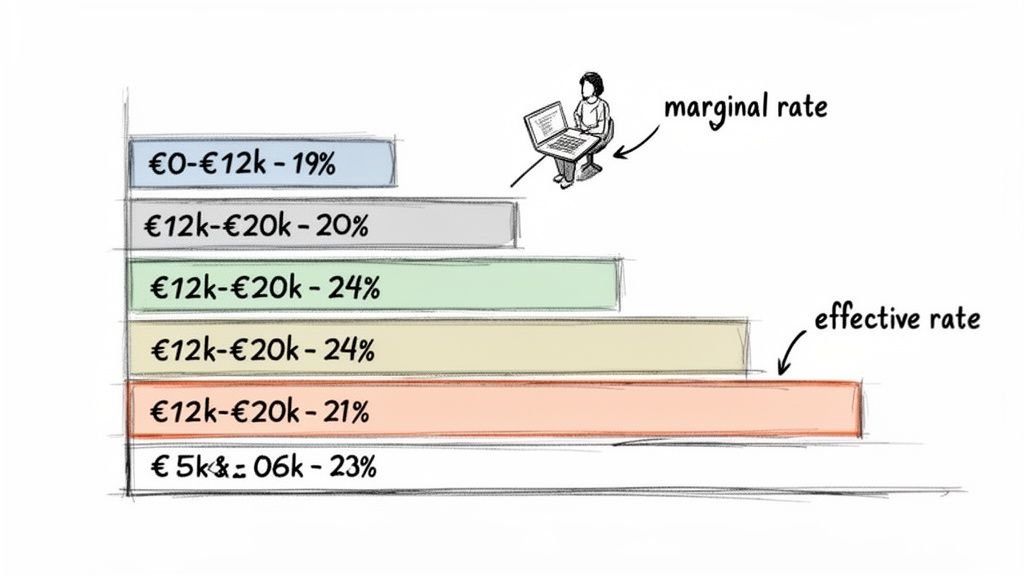
- Taxable base from €0 to €12,450: 9.5%
- Taxable base from €12,450 to €20,200: 12%
- Taxable base from €20,200 to €35,200: 15%
- And so on, with rates increasing progressively with income.
Each Autonomous Community has its own tax brackets. For example, in the Community of Madrid, the regional rates are also tiered, with the lowest bracket at 8.5%.
Calculation Example:
A resident of the Community of Madrid has a taxable “general income” of €10,000 after deductions. The tax they need to pay includes:
- National portion: €10,000 * 9.5% = €950
- Regional portion: €10,000 * 8.5% = €850
- Total tax rate: 18%
It’s important to note that all of an individual’s general income sources (like salary and rent) are aggregated, and the corresponding progressive tax rates are applied to the total amount.
Tax Structure for Savings Income (Renta del Ahorro)
Savings income covers capital gains from the sale of assets (like stocks or real estate), dividends, bank interest, and investment fund returns. Unlike general income, the tax rates for savings income are generally consistent at both the national and regional levels, applying a unified set of brackets.
Savings Income Tax Brackets:
- Taxable base from €0 to €6,000: 19%
- Taxable base from €6,000 to €50,000: 21%
- Taxable base from €50,000 to €200,000: 23%
- The portion exceeding €200,000 is taxed at a higher rate.
Calculation Example:
If a taxpayer has €6,000 of taxable savings income (e.g., from dividends) in a year, they will need to pay 19% tax on this income.
Since the calculation of Personal Income Tax involves multiple factors, proper tax planning based on individual financial circumstances is crucial.
