Frequent Visits Signal Strategic Shift
Against the backdrop of a continuously adjusting global geopolitical landscape, Spanish Prime Minister Pedro Sánchez made his fourth trip to China in four years, visiting from April 11 to 15, 2025, by invitation. This high frequency of visits is widely interpreted internationally as a clear signal of Spain’s policy to ‘proactively strengthen’ ties with China, marking a strategic repositioning by Madrid within the EU. The aim is to elevate the Spain-China relationship from a traditional economic partnership to a stable pivot of geopolitical and institutional significance.
Several international media outlets have analyzed that the Sánchez government is practicing ‘multipolar realism’ through close engagement with China. With increasing uncertainty in transatlantic relations, deepening cooperation with China helps Spain expand its strategic space. Data shows that in 2025, Chinese investment in Spain increased significantly from approximately €149 million to over €600 million, providing a solid economic foundation for deepening bilateral relations. Politico.eu noted that China views Spain as a ’key node among the EU’s pragmatists,' helping to open diversified channels for EU-China communication beyond the Franco-German axis.
Economic Cooperation Moves Towards Structural Optimization
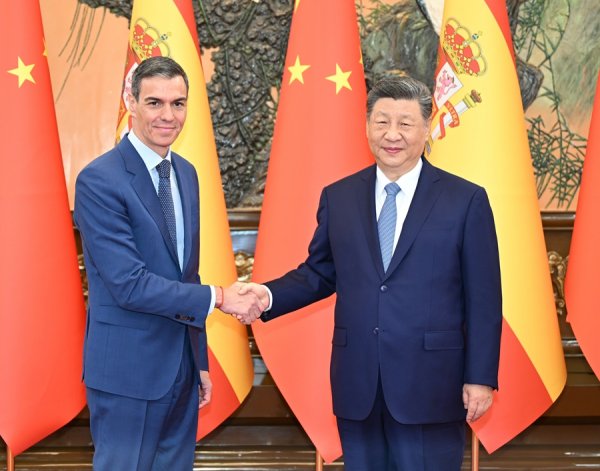
Economic cooperation was a core issue of Sánchez’s visit, with the focus shifting from sheer scale to structural optimization. According to data, the bilateral goods trade between China and Spain exceeded $55 billion in 2025, a year-on-year increase of 9.8%. However, Sánchez publicly stated that Spain’s trade deficit with China is ‘not sustainable,’ reflecting a new phase in Europe’s economic relationship with China, one that seeks rebalancing.
In the investment sphere, the logic of cooperation is also being upgraded. During his visit, Sánchez met with 36 Chinese entrepreneurs and actively invited Chinese companies to invest in Spain by establishing factories, R&D centers, and logistics platforms. Particular attention is being paid to the Spanish ventures of Chinese firms like CATL’s battery project and Chery Auto’s European hub. An expert from the Elcano Royal Institute, a Spanish think tank, analyzed that the true value of such investment lies in deep integration into the local industrial chain and technology transfer, rather than simply circumventing tariffs. This indicates that the Spain-China economic relationship is evolving from being ‘trade-driven’ to one of ‘industrial chain synergy,’ with its success depending on achieving a dynamic balance between technology sharing, local employment, and market access.
Coordinating on Global Order and the ‘Bridge’ Role
Another important dimension of the visit was coordination on the geopolitical order. According to Reuters, both sides sent a clear signal during their talks of ‘opposing the law of the jungle and upholding multilateralism.’ Sánchez repeatedly echoed the concepts of a ‘multipolar world’ and a ‘rules-based order,’ seen as a moderate European course correction against unilateralist tendencies.
International opinion widely holds that Spain’s role as a ‘bridge’ and mediator in EU-China relations has significantly grown. A consensus has formed among major Spanish think tanks, including the Barcelona Centre for International Affairs (CIDOB), advocating for a pragmatic China policy within the overall EU framework that is ‘de-ideologized and re-functionalized.’ Spain is not deviating from the EU’s path but is instead playing the role of an ‘intra-system regulator,’ providing a low-friction communication interface for EU-China relations. This positioning holds unique value in the interaction between China and the EU.
Achievements, Challenges, and Future Outlook
In a press conference after his visit, Sánchez stated that Spain welcomes more Chinese tech and advanced manufacturing companies to invest in the country and hopes to jointly explore third-party markets with Chinese partners, such as those in Africa and Latin America. The visit has undoubtedly injected new momentum into Spain-China relations, and its pragmatic orientation offers a model of a ‘non-confrontational cooperation paradigm’ for global multipolar development.
However, the Sánchez government also faces domestic constraints. Spain’s public debt is approaching 100% of its GDP, limiting its policy flexibility amidst EU fiscal rules and a global economic slowdown. Furthermore, as a minority government, Sánchez relies on a complex ruling coalition, which can hinder the implementation of major policies. Looking ahead, the key to the long-term stability and success of the comprehensive strategic partnership will be whether the high-level political consensus can be effectively translated into deep integration at the industrial and regulatory levels.
