Recently, residents of the Mediterranean island of Tabarca have proposed separating from the jurisdiction of the Alicante city government, seeking to establish a ‘minor local entity’ with greater self-governance. This move adds a new chapter to the small island’s tumultuous history.
The Evolution of a Name: From Planesia to Nueva Tabarca
The historical names of Tabarca Island have changed several times. The earliest record dates back two millennia to the Greek geographer Strabo, who called it ‘Planesia’. There are two theories about the origin of this name: one suggests it refers to its flat terrain (the island is also known as ‘Isla Plana’ or Flat Island), while another implies it was ‘dangerous’ to navigate due to the surrounding reefs.
Later, the Romans named it ‘Planaria’ because of its landscape. In the 12th century, the Arab geographer Al-Idrisi recorded it as ‘Planasia’. From the 15th to the 18th century, ‘Isla de Santa Pola’ became its common name.
It wasn’t until the 18th century, with the establishment of a modern settlement, that the island was officially named ‘Nueva Tabarca,’ a name it retains today. Interestingly, its popular short name, ‘Tabarca,’ is not the full official title.
Complex Administrative History: The Elche and Barcelona Periods
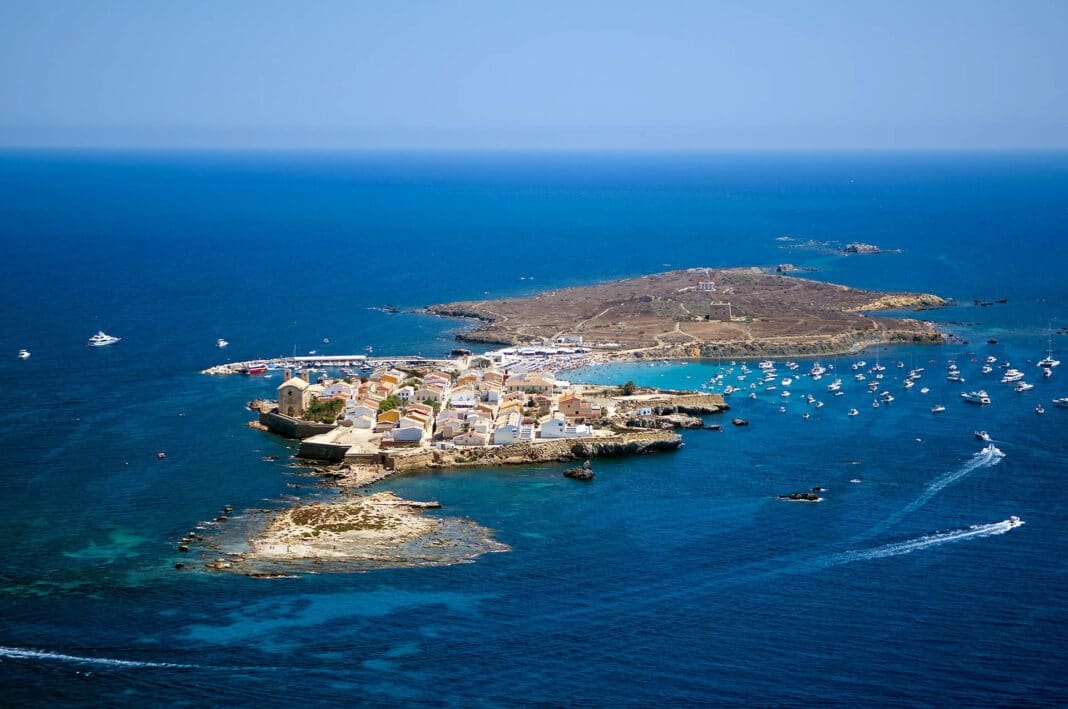
In terms of administration, Tabarca Island was initially more closely linked to Elche and Santa Pola. Geographically, the island is only 8 kilometers from Santa Pola, compared to 20 kilometers from Alicante, the city that currently governs it.
The Elche Period: After the Christian Reconquista in the 13th century, Elche claimed sovereignty over the island. Since Santa Pola historically served as Elche’s port, the island was known as ‘Isla de Santa Pola’ on maps from the 15th to the 18th centuries and was considered Elche’s territory for centuries. Records show that in 1337, Ramon Berenguer, son of King James II of Aragon, authorized Elche to build a defensive tower on the island, although the project was never completed.
The Barcelona Period: At the end of the 14th century, a historical curiosity led to a dramatic change in the island’s ownership. To raise funds for the war in Sicily, King Martin I (Martí l’Humà) sold Elche, along with Tabarca Island, to Barcelona. Consequently, between 1392 and 1473, this small Mediterranean island was briefly administered by the city that is now the capital of Catalonia.
Genoese Settlers and the Formation of a Modern Settlement
For a long time, Tabarca Island remained uninhabited due to constant pirate attacks. In 1770, King Charles III of Spain took a decisive step: he ordered the settlement of a group of Genoese-origin residents who had been rescued from Tabarka, Tunisia, on the island.
The move was intended to defend against pirates by establishing a permanent settlement. These Genoese immigrants built a fortified wall, a church, and houses, forming the village structure that exists today. To honor their place of origin, the island was officially renamed ‘Nueva Tabarca’ (New Tabarca). To this day, many typical Genoese surnames can still be found among the island’s inhabitants. Following this, administrative control of the island was officially transferred to Alicante.
Seeking Autonomy: A ‘Forgotten’ Island’s Modern Plea
Since the post of military governor on the island was abolished in 1850, Tabarca’s dependence on the Alicante city government has grown. However, due to its remote location, infrastructure development on the island has long lagged behind. The Alicante government later eliminated the position of ‘island mayor’ (alcalde pedáneo), established in the late 19th century, deeming it obsolete. The last person to hold the post, Cayetano García, expressed concern, fearing the move would leave island affairs without anyone in charge.
The current head of the neighborhood association, Carmen Martí, states bluntly that residents feel ‘abandoned’ by the Alicante government and wish to gain more autonomy by forming a minor local entity. This would allow them to elect their own president (equivalent to a mayor) and council members. Despite external doubts about whether the island’s tax revenue could support self-governance, the residents’ determination to pursue greater autonomy remains unshaken. According to reports, at the most recent meeting on May 5, 2025, the two sides failed to reach an agreement, and this struggle over identity and governance continues.
