Every April 23rd, the northeastern Spanish regions of Catalonia and Aragon celebrate their important patron saint’s day, Sant Jordi’s Day (Día de San Jorge). This festival, with diverse origins and celebrations in different areas, has evolved into a major regional event blending culture, commerce, and romance.
Festival Origins: Military Legends and the Dragon-Slaying Tale
The origin of Sant Jordi’s Day has two main versions in different parts of Spain.
In the region of Aragon, the festival is linked to a significant military victory. According to legend, in 1096, during the battle to conquer Huesca, Saint George appeared as a knight and helped King Peter I of Aragon achieve victory. To commemorate this, the Aragonese monarchy established a festival in his honor. Since 1461, April 23rd has been the official day of celebration in Aragon, with commemorative events still held in Zaragoza’s Plaza de Aragón.
In Catalonia, a more romantic legend prevails. The story tells of a fierce dragon terrorizing a village, and a princess was unfortunately chosen as a sacrifice. Just in time, a knight named George appeared, slew the dragon, and saved her. From the dragon’s blood, a red rose bush grew, and the knight presented a rose to the princess. This tale forms the basis for the tradition of exchanging roses on Sant Jordi’s Day in Catalonia.
Modern Customs: A Fusion of Roses, Books, and Commerce
In contemporary Catalonia, Sant Jordi’s Day has become a cultural event embraced by all. The festival’s signature custom is for men to give women a red rose, symbolizing courage and love, while women reciprocate with a book, representing knowledge and wisdom. This day is often celebrated as the region’s own version of Valentine’s Day.
The tradition of giving books dates back to 1923. At that time, booksellers in Barcelona, a major publishing hub, began promoting book sales on this day, successfully merging culture with the festival. This initiative perfectly aligns with the theme of World Book Day, which is also celebrated on April 23rd. Statistics show that on this day, around 6 million roses and 800,000 books are sold in Catalonia, demonstrating its immense commercial impact.
Festive Sights: From City Landmarks to Special Delicacies
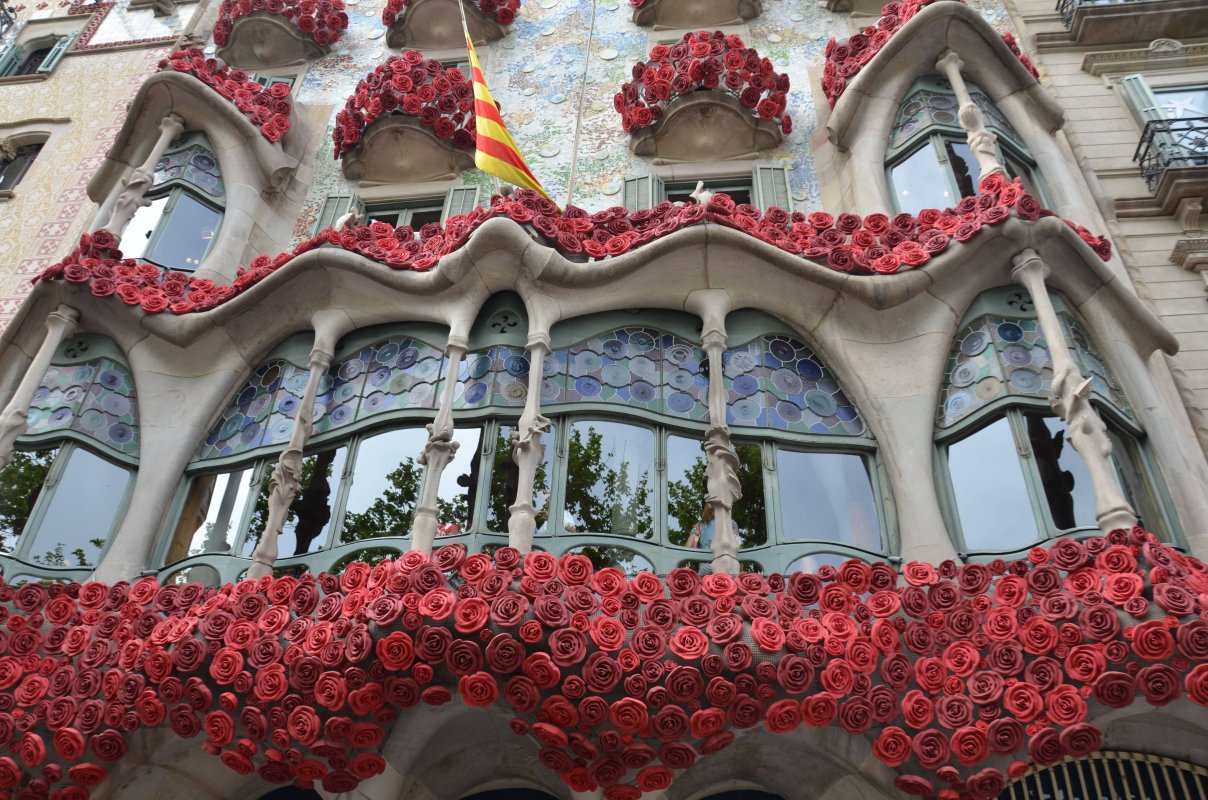
During the festival, Barcelona’s main streets, such as La Rambla and Passeig de Gràcia, are filled with stalls selling roses and books. Many buildings in the city also join the celebration. The most notable is Antoni Gaudí’s Casa Batlló, whose façade is adorned with a multitude of red roses, evoking the legend of the dragon’s lair and becoming a popular photo spot for tourists and locals alike.
Beyond the visual feast, Sant Jordi’s Day also offers a unique culinary experience. Local bakeries create a special dessert called “Sant Jordi Cake” (Pastel del día de San Jorge). It is designed to resemble the red and yellow stripes of the Catalan flag, adding a sweet touch to the festivities.
