An in-depth research report jointly released by Spain’s Ministry of Consumer Affairs (Ministerio de Consumo) and the Spanish National Research Council (CSIC) reveals the highly concentrated state of the country’s rental housing market. The report indicates that the Spanish rental market is no longer dominated by small, individual landlords as traditionally perceived, but is instead controlled by a few individuals and institutions holding multiple properties. This structural imbalance is a key reason for the vulnerable position of tenants.
Market Structure Overturned: Large Landlords Become the Dominant Force
Key data from the report shows that 61% of properties in the Spanish rental market are controlled by ‘multi-property landlords’ (individuals with two or more rental properties), corporations, investment funds, or public entities. In contrast, small landlords who own only one rental property control just 39% of the market share.
This concentration on the supply side starkly contrasts with the dispersed demand. Data shows that only 4.9% of Spain’s population earns income from renting out property, while over 20% of the population are renters. The study explicitly challenges the traditional view of ‘vulnerable small landlords being the market core,’ confirming that professional landlords with multiple properties are now the prevailing model.
Growth Trend Analysis: Concentration Process Continues to Accelerate
The report further tracks market evolution from 2016 to 2023. During this period, the total number of rental homes in Spain grew from 1.9 million to 2.57 million, but this growth was primarily driven by the large landlord group. Data reveals that the number of properties held by small landlords increased by 30.4%, while multi-property landlords expanded their portfolios by nearly 40% over the same period, indicating that the trend of market concentration has been accelerating in recent years.
Significant Regional Differences: Capital Accumulation Effect in Major Cities
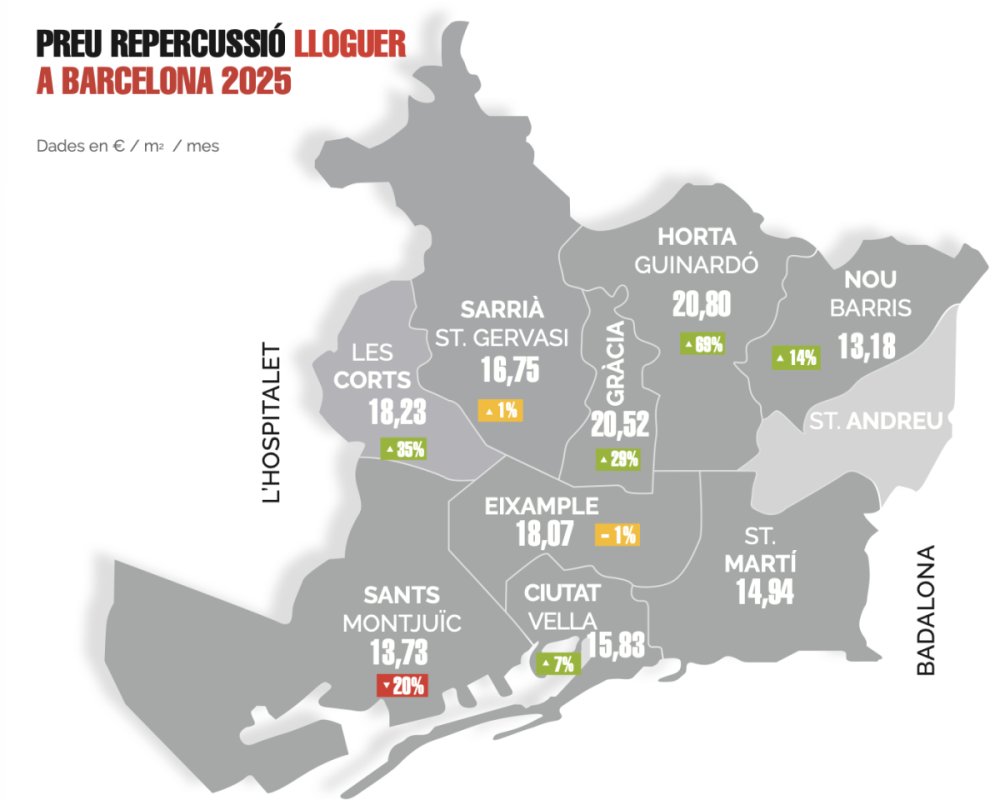
The phenomenon of property concentration is particularly pronounced in major cities with high-pressure real estate markets. In metropolitan areas like Madrid, Valencia, and Barcelona, the proportion of properties controlled by multi-property landlords is significantly higher than the national average. In Barcelona, this figure exceeds 60%, and in Las Palmas, it reaches as high as 65%. This indicates that in areas with high economic activity and strong housing demand, the monopolistic trend of capital and professional landlords is more severe.
The Role of Institutional Investors: A Significant Professional Force
In addition to individual multi-property landlords, the role of professional entities such as corporations, investment funds, and asset management companies is also becoming increasingly important in the rental market. According to statistics, these entities rent out approximately 223,500 homes, accounting for 8% of the total market. If the roughly 300,000 public social housing units are included, the proportion of properties controlled by various institutions (both public and private) reaches 17%.
The Ministry of Consumer Affairs concludes in the report that while the small landlord group still exists, it no longer holds a central position in the market. Today, the group of professional landlords with multiple properties holds decisive power, and this concentration trend is expected to strengthen further in the coming years.
