Widespread Chaos Erupts Over New EU Border System as Passengers Block Plane at Marseille Airport
In April 2026, coinciding with the Easter travel peak, the EU’s newly launched Entry/Exit System (EES) triggered unprecedented chaos at 15 major European airports. The system caused a drastic drop in border check efficiency, leading to tens of thousands of travelers facing long delays or missing their flights. At Marseille Provence Airport in France, the situation escalated into a heated confrontation, with dozens of passengers storming the tarmac in an attempt to physically block their plane from taking off.
Marseille Airport: Passengers Rush Runway to Stop Plane
The incident occurred last Saturday evening (April 2026) at Marseille Provence Airport. Ryanair flight FR2640, scheduled to depart for Marrakech, Morocco at 10:30 PM, was unable to board on time as over 80 passengers were stuck at border control. Due to the extremely slow processing speed of the new EES, the border check queues came to a standstill for an extended period.
With the plane about to depart, the stranded passengers’ frustration boiled over. Video footage shows dozens of people breaking through the boarding gate and security lines, entering the tarmac, and running directly in front of the taxiing Boeing aircraft. They waved their arms and shouted protests at the pilots in the cockpit, trying to prevent the plane from taking off without them. The standoff lasted for over three hours, but the aircraft eventually departed at 1:50 AM the next morning, leaving the passengers behind in Marseille. According to reports, a female passenger was arrested on the spot by French police for allegedly deactivating an airport fire safety system to help the crowd access the runway.
Root of the Chaos: The Rushed Launch of the EES Biometric System
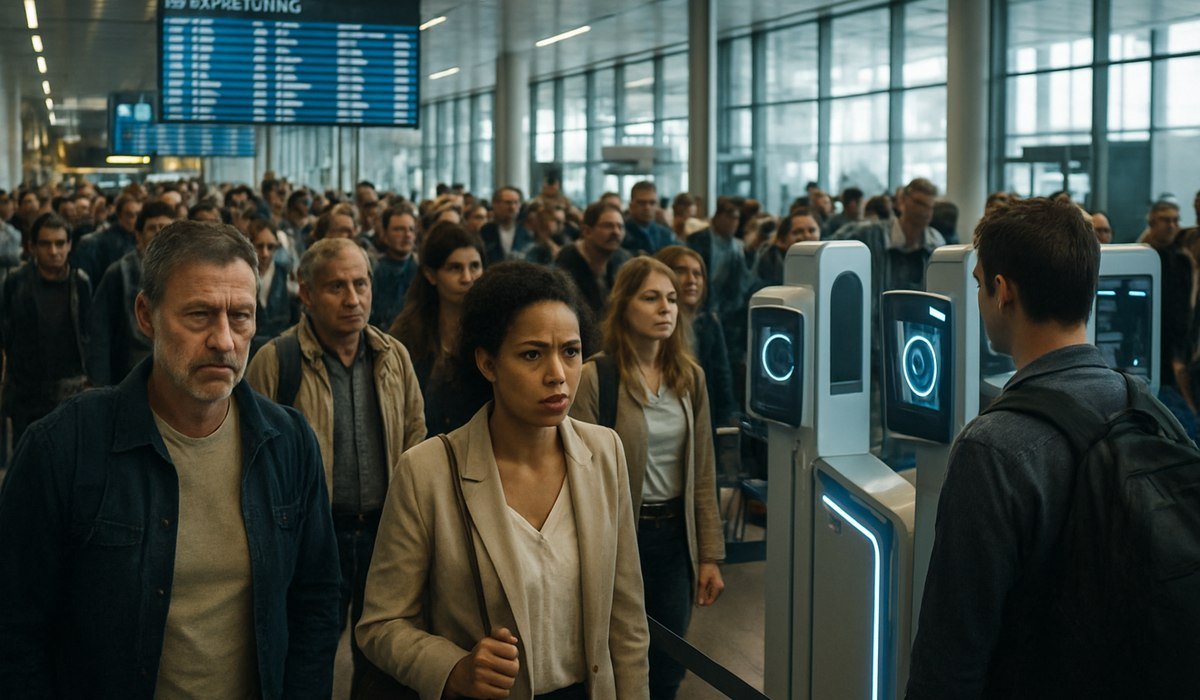
The direct cause of this widespread chaos is the EU’s Entry/Exit System (EES), which was officially fully launched on April 10, 2026. The system requires all non-EU citizens entering the Schengen Area (including those from the UK, US, and China) to provide biometric data upon entry, such as fingerprints and facial photos. They must also present supporting documents for accommodation, funds, insurance, and return tickets.
Although the EES was intended to enhance border management efficiency and security through digitalization, its real-world application has revealed serious flaws. Olivier Jankovec, Director General of Airports Council International (ACI) Europe, pointed out that the system’s design underestimated the pressure from actual passenger traffic. The border processing capacity at airports across various countries was far from adequate to handle the complex registration process, causing the system to face collapse right after its launch.
Chain Reaction: Major Airports Paralyzed Across Europe
The Marseille incident was not an isolated case. Following the EES launch, air travel across Europe has been severely impacted:
- Spain and Portugal: At Málaga and Almería airports in Spain, biometric machines frequently malfunctioned, leaving staff helpless. In Portugal’s Lisbon, Porto, and Faro airports, excessively long queues caused numerous passengers to miss their flights, forcing airport authorities to eventually suspend EES registration and revert to manual passport stamping to manage the crowds.
- Germany and Belgium: At Berlin, Munich, and Frankfurt airports in Germany, three-hour queues became the norm. At Brussels Airport in Belgium, one traveler documented their experience of waiting in line for three hours with an 8-month-old baby.
- Italy and the Netherlands: At Milan Linate Airport in Italy, the long waits and poor ventilation led to passengers vomiting and even fainting. Amsterdam Schiphol Airport in the Netherlands was also paralyzed, with officials only able to issue warnings of ‘significant delays’.
- France: At Paris Charles de Gaulle Airport, a major hotspot for the chaos, some travelers reported waiting in immigration queues for up to four hours—longer than their actual flight time.
In response to the widespread delays and chaos, airlines like Ryanair have issued statements urging national border authorities to ‘make full use of flexibility’ to prevent such unacceptable delays from continuing. This incident highlights the immense cost of the EU’s failure to conduct adequate stress tests and provide sufficient staff training when implementing major policies—a cost ultimately borne by tens of thousands of travelers.
