Decree Rejected, Two-Year Extra Extension Fails
The Spanish rental market is experiencing significant legal turmoil. Recently, a Royal Decree proposed by the Sumar party, aimed at providing tenants with an additional two-year mandatory lease extension, was rejected in a vote by the Spanish Congress of Deputies. This outcome severely limits the decree’s applicability.
According to analysis by José Ramón Zurdo, General Director of the Rental Negotiation Agency (Agencia Negociadora del Alquiler, ANA), the decree is legally binding only for tenants whose lease contracts expired between March 22 and April 28. Tenants whose contracts expire after this period cannot invoke the decree to request an extra extension and must adhere to their original contract terms to avoid potential legal action.
Three Core Variables Determining Lease Terms
Lawyer Zurdo points out that under the current complex legal framework, determining the actual maximum term of a rental contract requires considering three core factors: the ‘who’ (landlord and tenant identity) and the ‘where’ (property location).
Landlord Type: Individual vs. Legal Entity
The legal status of the landlord is the primary determinant of the base lease term. If the landlord is an individual (particular), the legally mandated term is 5 years. If the landlord is a legal entity, such as a company (persona jurídica), the mandatory term is extended to 7 years.
Property Location: Special Rules for Rent-Pressure Zones
If the rental property is located in a government-designated “rent-pressure zone” (zona de mercado residencial tensionado), tenants have stronger renewal rights. In these areas, after the 5 or 7-year mandatory term ends, the tenant has the right to request a mandatory special extension of up to 3 years, which the landlord generally cannot refuse.
Tenant Status: Extra Protection for Vulnerable Groups
The law provides additional protection for tenants in a vulnerable socioeconomic position. If a tenant can prove they belong to a “vulnerable group” (colectivo vulnerable), they can apply for a one-year special extension after the statutory lease term ends.
Landlord Essentials: Critical Legal Deadlines to Know
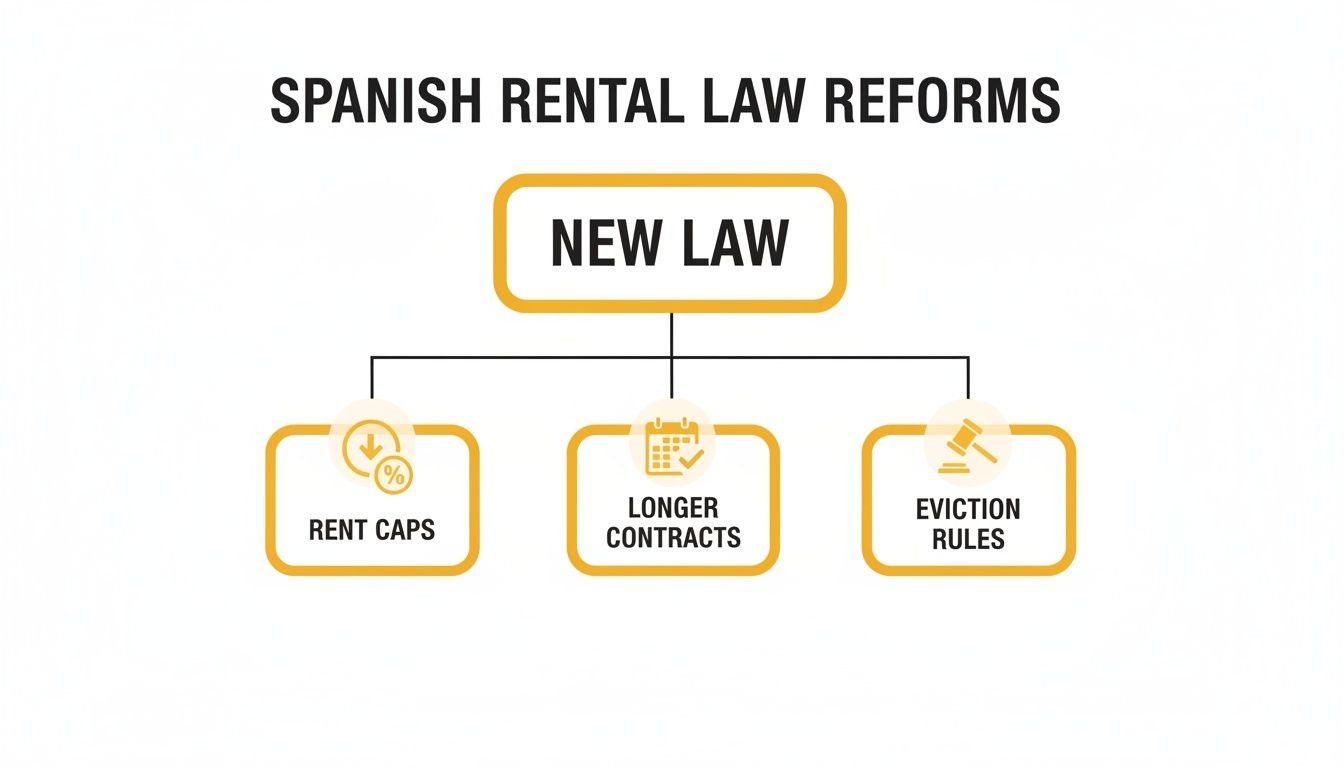
In addition to the core variables above, certain procedural rules are equally crucial. Failure by landlords to comply can lead to serious financial and legal consequences.
The “4-Month Notice Period” and “3-Year Tacit Renewal”
Current law stipulates that if a landlord does not wish to renew the contract upon the expiration of the statutory term, they must notify the tenant in writing at least 4 months in advance. If the landlord fails to provide notice within this timeframe, the contract will automatically enter a state of “tacit renewal” (tácita reconducción) for a new term of up to 3 years. In contrast, if a tenant decides not to renew, they only need to give the landlord 2 months’ notice.
Legal Requirements for Reclaiming Property for Personal Use
An individual landlord wishing to reclaim the property during the contract term for their own use or for a direct relative (parents, children) must meet two prerequisites: first, this possibility must be explicitly stated in the lease agreement’s clauses; second, the landlord can only exercise this right after the tenant has completed at least one full year of the lease.
Expert Advice: Navigating Risks in a Complex Legal Landscape
Given the current complexity, volatility, and partial retroactivity of Spanish housing rental laws, legal expert José Ramón Zurdo strongly advises both landlords and tenants to seek professional legal counsel before signing or renewing any lease agreement. A minor clerical error or a misunderstanding of the regulations could lead to years of legal disputes and unnecessary losses in the future.
