Indefinite Teacher Strike Looms in Valencian Community, End-of-Term Activities Face Paralysis
Starting Monday, May 11, 2026, public school teachers in the Valencian Community will launch an indefinite strike after negotiations over salaries and educational improvements completely broke down. The strike is expected to severely impact the daily teaching and final evaluations for nearly 78,000 educators and numerous students across the region.
Negotiations Collapse, Strike Becomes Inevitable
The decision to strike came after the final round of negotiations failed on Thursday, May 7. The salary proposal from the Valencian Department of Education was deemed insincere and failed to meet the unions’ core demands. In contrast, the teachers’ unions insisted on the immediate fulfillment of all promises, a demand the regional government, citing financial difficulties, found unacceptable. With multiple mediation attempts proving fruitless, the strike has become unavoidable.
This action is a joint effort by the five main teachers’ unions (STEPV, CC. OO. PV, UGT PV, ANPE CV, CSIF CV), marking the most unified front since the 2012 financial crisis. The strike call covers nearly 78,000 educators from early childhood education to high school and vocational training (FP).
Long-Standing Grievances: The Unions’ Six Core Demands
The roots of this labor dispute trace back to the beginning of the school year. As early as late September, the three major unions—STEPV, CC. OO. PV, and UGT PV—submitted a negotiation document to the government with six core demands:
- Salary increases to combat inflation.
- Reduced student-to-teacher ratios to improve educational quality.
- Less bureaucracy to reduce teachers’ administrative workload.
- Increased investment in infrastructure.
- Expansion of the teaching staff.
- Promotion of teaching in the Valencian language.
Despite two short-term strikes on December 11 and March 31, dozens of protests, and a change in the head of the Department of Education from José Antonio Rovira to Carmen Ortí, the government has consistently cited a “lack of funds.” It has failed to make substantial commitments on the key issue of salary increases, proposing to delay discussions until the autumn budget is released—a move the unions view as a stalling tactic.
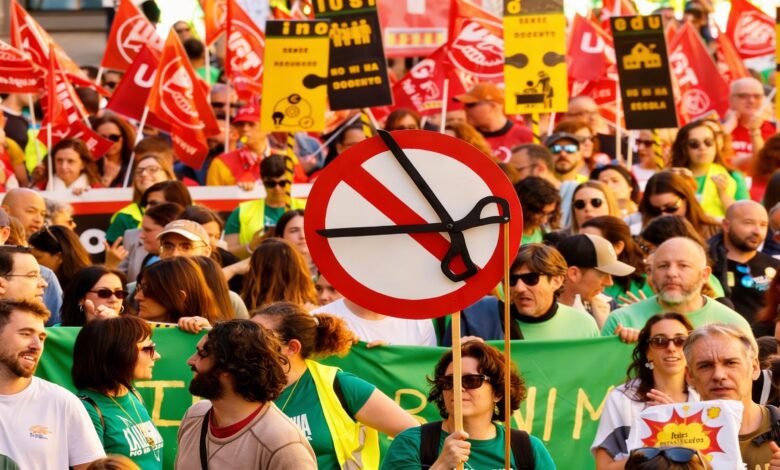
“Minimum Services” Spark Controversy, Student Evaluations Impacted
To manage the strike, the Valencian government has mandated “minimum services,” requiring 100% of final evaluation services to be guaranteed for second-year Bachillerato students (high school seniors) at a critical point for university admission. However, this regulation has intensified the conflict, with unions deeming it unreasonable and considering legal action. Meanwhile, some teachers have even proposed protesting by giving all students a perfect score of 10.
For other grades, the government has not established effective safeguards. Schools are only required to maintain a “custodial” model, with just one teacher assigned for every four primary school classes and every ten middle school classes. This means that final evaluations for third and fourth-year ESO students (middle schoolers needing grades for scholarships or high school applications) cannot proceed normally. School administrators predict that if just 20% to 30% of teachers strike, schools will be paralyzed. Subject-specific teachers will be forced into supervisory roles, and students requiring special support will lose necessary assistance.
Widespread Public Support Amidst Government’s Financial Woes
Unlike in the past, this teacher strike has garnered widespread sympathy and support from all sectors of society. From well-known artists to parent associations, many have publicly backed the teachers’ demands, with little opposition voiced. Protest posters with slogans like “The teachers are fighting” are displayed inside and outside schools, demonstrating strong public backing.
Facing the unions’ firm stance and broad public support, even the mediation efforts of the newly appointed President of the Valencian Community, Juanfran Pérez Llorca, have failed to break the deadlock. The government continues to emphasize its financial difficulties, stating it cannot immediately meet all of the unions’ demands, leading to a stalemate.
