On May 10, Spanish authorities conducted two major maritime rescue operations in the waters off the Canary Islands, saving over 150 migrants from two precarious vessels. This once again highlights the harsh reality of what is known as one of the world’s most dangerous migrant routes.
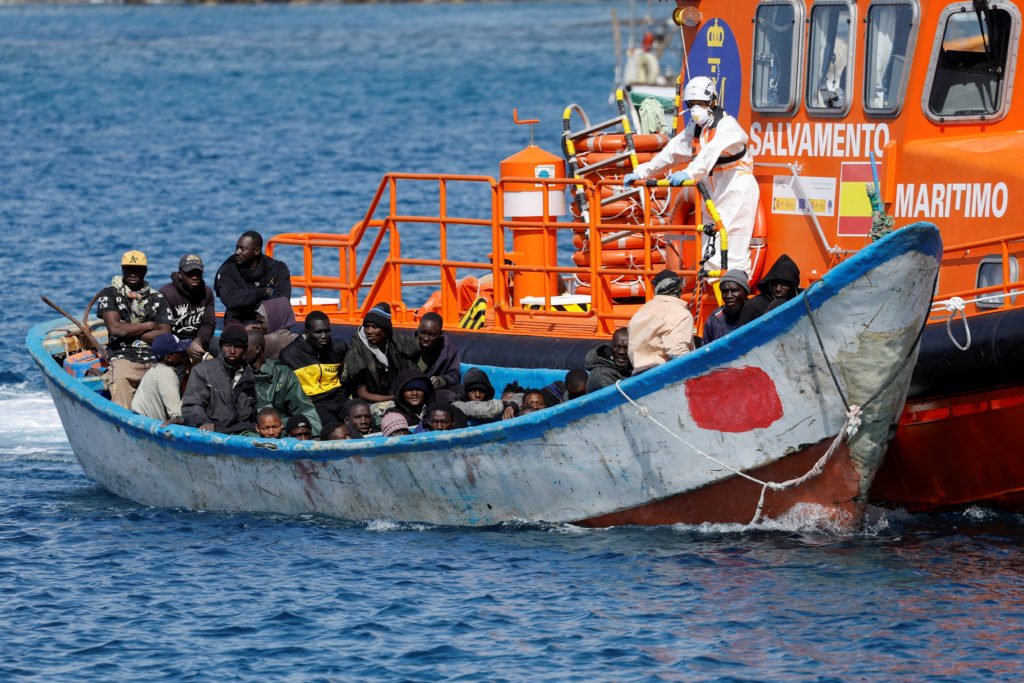
The Hundred-Person Wooden Boat off Tenerife
Around 10:25 AM, the merchant vessel ‘Bentayga’ first raised the alarm about 3.7 kilometers off the coast of Las Galletas in southern Tenerife, reporting an overloaded traditional wooden boat, known as a ‘cayuco’. Spain’s Maritime Rescue Agency (Salvamento Marítimo) quickly dispatched two rescue vessels, ‘Alpheratz’ and ‘Menkalinan’, to the scene. The cayuco was carrying over 100 migrants, believed to have departed from the West African nation of Gambia a week prior. All individuals were safely escorted to the port of Los Cristianos for medical assistance and registration by the Red Cross and the Spanish National Police.
The Semi-Submerged Dinghy off Lanzarote
Just two hours later, another emergency unfolded. The Maritime Rescue Agency’s patrol aircraft, ‘Sasemar 103’, spotted a sinking inflatable boat in the waters east of Lanzarote. Reports indicated that one of its inflatable tubes had completely deflated, and none of the 55 people on board were wearing life jackets. The fast rescue boat ‘Al Nair’ arrived after 2:00 PM and transferred everyone to the port of Arrecife for assessment. Maritime officials stated that if not for the timely discovery, the incident could have easily turned into a tragic maritime disaster.
A Double Test for the Rescue System
This series of intense rescue operations occurred while the Canary Islands’ emergency response system was already under immense pressure. Local authorities were simultaneously managing the quarantine of the cruise ship ‘MV Hondius’ due to a Hantavirus outbreak. Despite this, Spanish officials praised the efficient coordination among the Coast Guard, port police, and medical services under multiple pressures, describing their performance in avoiding resource conflicts as ‘textbook-perfect’.
The Perilous Canary Route
In recent years, the Atlantic crossing from the West African coast to the Canary Islands has become one of the main routes for African migrants to enter Europe. Migrants from countries like Gambia, Senegal, and Mauritania often attempt the journey of hundreds or even thousands of kilometers in extremely rudimentary and heavily overcrowded wooden boats or inflatable dinghies, braving treacherous sea conditions. The UN’s International Organization for Migration (IOM) has designated this route as one of the deadliest in the world, with countless lives lost during the voyage.
