Cervantes Manuscript Reappears on the Auction Market
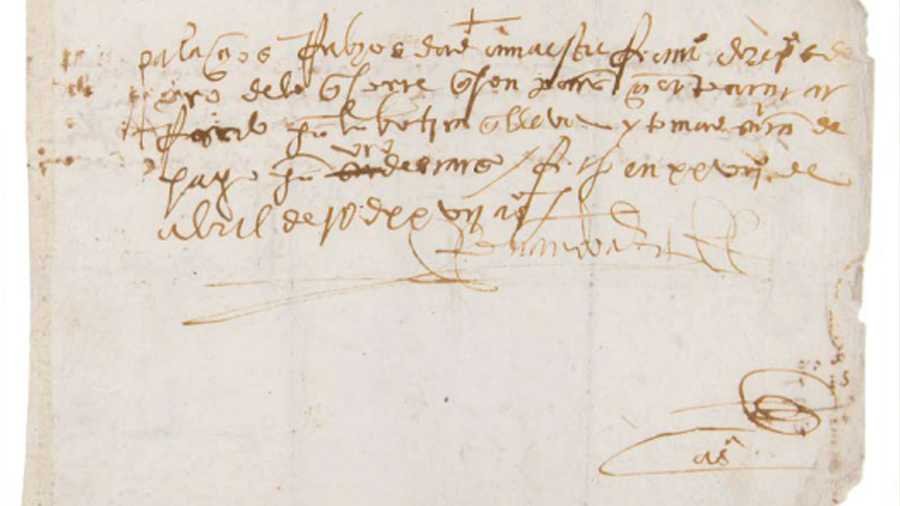
Recently, a rare manuscript personally signed by the Spanish literary giant Miguel de Cervantes on July 8, 1593, has surfaced at the Durán Arte y Subastas auction house in Madrid. The document is scheduled for public auction on May 27 with a starting price of €120,000. The manuscript is an official receipt, confirming that Cervantes received a salary of 600 silver reales from Andrés de Cerio for his service on the Isunza commission. Measuring 31.4 by 20 cm, the document remains in good condition with clear handwriting, despite some ink corrosion over more than four centuries.
A Controversial History: A Stolen National Treasure?
The manuscript’s appearance has sent shockwaves through Spain’s cultural and legal circles, reigniting a fierce debate over its ownership. The Regional Government of Andalusia (Junta de Andalucía) has long maintained that the manuscript is a national treasure and public property, illegally torn out and stolen from the notarial historical records of the Historical Archive of Seville (Archivo Histórico de Protocolos de Sevilla).
A Tortuous Legal Battle
This is not the first time the manuscript has been at the center of a legal dispute. Back in 1998 (the original source indicates that a mention of 1598 was a typo), when the document was first put up for auction in Barcelona, the Andalusian government intervened forcefully. At that time, the authorities successfully obtained an emergency injunction from a court in Palma de Mallorca to halt the auction. However, in the subsequent lawsuit aimed at establishing state ownership, an appellate court in 2007 rejected Andalusia’s claim due to an incomplete chain of evidence. Now, this once-controversial artifact is reappearing through a fully legal commercial process.
Inestimable Historical Value
As Alejandro Torres Ridruejo, a lawyer for the Andalusian government, noted in a 2012 legal research article, administrative documents related to Cervantes possess immense historical value. Since the literary master’s personal diaries, letters, and creative manuscripts are almost entirely lost, the few surviving authentic autographs of Cervantes are nearly all official documents like this one. Each is considered an irreplaceable, top-tier piece of cultural heritage for Spain and, indeed, the world.
An Unresolved Future
Years later, as the manuscript enters the auction process again in 2026, the cross-regional heritage recovery dispute has been reignited. Observers are keenly watching whether the Andalusian government’s legal department will once again request an emergency court order to prevent the precious document from being sold to a private collector. This clash between cultural heritage protection and legal commerce has become the most-watched event in the European art world this month.
