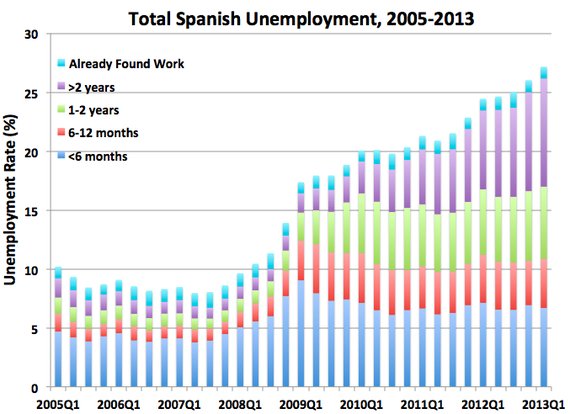
According to a report from Spanish financial media on May 19, 2026, Spain’s labor market is undergoing a profound structural contradiction. While the national unemployment total remains above 2.6 million, businesses are increasingly struggling to hire, leading to a persistently high number of job vacancies.
## Cost Pressures Lead to Record-High Hiring Abandonment
This phenomenon is revealed in the ‘Quarterly Labor Cost Survey’ report published by the Spanish National Statistics Institute (INE). By the end of 2025, the number of unfilled job vacancies nationwide had approached a historic high of nearly 156,000. Meanwhile, the percentage of companies that explicitly abandoned hiring plans due to ‘excessively high employment costs’ reached 5.3%, the highest figure since records began in 2013.
Although 91% of companies reported having no current hiring needs, a growing number of employers admit that even if they needed staff, they would be deterred by the constantly rising labor costs.
## Multiple Policy Factors Drive Up Labor Costs
The business community widely believes that continuously rising labor costs are the core reason for suppressed hiring intentions. Specifically, the cumulative effect of several policies has significantly increased corporate expenditures:
- Significant Minimum Wage Hikes: Since a one-time increase of 22.3% in 2019, Spain’s minimum wage has continued to rise.
- Labor Law Reform: The labor reform implemented in 2022 strictly limited the use of temporary contracts, increasing the fixed costs of employment for companies.
- Increased Social Security Contributions: In conjunction with pension system reforms, the social security contribution burden for both companies and employees has further increased.
Furthermore, inflation sparked by the war in Ukraine and geopolitical tensions have placed additional pressure on business operations, making them more sensitive to new costs.
## High-Skilled Sectors Are Particularly Hard-Hit
Contrary to common perception, the phenomenon of abandoning hiring due to cost issues has impacted high-skilled fields even more than low-wage sectors. Data shows that in the ‘professional, scientific, and technical activities’ sector, this proportion reached 8%, the highest among all industries, affecting positions such as lawyers, architects, researchers, and accountants. This was followed by the public administration sector, at 7.6%.
Meanwhile, the hospitality industry (6.5%) and administrative and support service activities (6.2%), which are more sensitive to changes in minimum wage and labor laws, were also significantly impacted.
## Supply-Demand Imbalance: A Structural Problem Beyond Costs
The report also points out that while the 5.3% figure is a new record, its overall scale within the economy remains relatively limited. The current tension in Spain’s job market also stems from deep-rooted issues on the labor supply side. These include a mismatch between job seekers’ skills and market demand, the reluctance of some candidates to accept working conditions in certain industries, and the possibility that some public welfare policies may have weakened the employment motivation of certain groups. These factors collectively exacerbate the supply-demand imbalance in the labor market.
