Madrid Prepares for Major Traffic Disruptions During Papal Visit
In preparation for the visit of Pope Leo XIV from June 6 to 9, 2026, the Spanish capital of Madrid is set to launch an unprecedented urban coordination and traffic management plan. Madrid’s Mayor, José Luis Martínez-Almeida, has warned the public that the city’s traffic situation will face ‘very difficult’ challenges in the coming days due to the event’s massive scale.
Unprecedented Scale: Crowds Expected to Exceed One Million
The scale of urban management for this papal visit has been officially described as ‘extremely significant,’ with a complexity comparable to the 2022 NATO Summit held in Madrid. According to diocesan forecasts, the main events will take place at Plaza de Cibeles and Plaza de Lima. Approximately 500,000 people are expected to gather around Plaza de Lima, while the crowd at Plaza de Cibeles could peak at 1.5 million. The Madrid City Council is using these figures as a baseline and preparing for even larger numbers to handle the immense crowd pressure.
Phased Implementation of Traffic Restrictions
Traffic restrictions will begin in late May and escalate progressively, primarily affecting the following two key areas:
Restrictions at Plaza de Cibeles
- From Saturday, May 23: The right lane of Paseo de Recoletos (northbound) will be permanently occupied.
- From Monday, May 25: The night bus stop area in the square will be occupied. Additionally, three lanes on Paseo de la Castellana will be closed for the construction of a choir platform.
- From Thursday, June 4: To prepare for the Corpus Christi Mass led by the Pope on June 7, extensive road closures will be implemented around Plaza de Cibeles, bringing traffic to a near standstill.
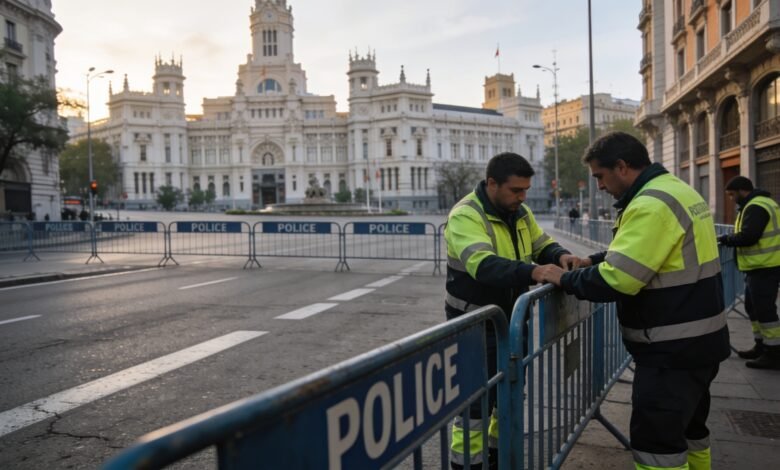
Restrictions at Plaza de Lima
- From Monday, May 25: The central lanes of Paseo de la Castellana near Plaza de San Juan de la Cruz will be occupied, but vehicles can still use the side service roads.
- From Wednesday, June 3: To ensure the smooth running of the vigil on June 6, the central lanes of Paseo de la Castellana will be almost completely closed, marking a critical point of traffic impact. Some northbound lanes in this area will have already been closed prior to this date.
Travel Advice and Alternatives for the Public
In response to the foreseeable traffic congestion, the Madrid City Council has issued detailed travel recommendations:
- Driving: Starting from May 25, officials strongly advise the public to avoid driving into the city center. If driving is necessary, the M-30 ring road should be prioritized as the main route. The City Council has collaborated with navigation apps like Google Maps and Waze to provide real-time updates on road closures and detours.
- Alternative Routes: For vehicles needing to travel within the M-30 ring, options include Bravo Murillo or Santa Engracia streets in the west; Serrano or Velázquez streets for north-south travel in the east; and Costa Rica or Alberto Alcocer streets for east-west crossings.
- Public Transport: To encourage the use of public transportation, the EMT bus system and the BiciMAD bike-sharing service will be free to the public from June 3 to 9. On the peak days of June 6 and 7, up to 184 additional buses will be deployed. However, please note that due to road closures, 22 bus routes around Plaza de Lima and 25 routes around Plaza de Cibeles (including the Airport Express) will be temporarily diverted.
Security and Community Cooperation
A large-scale security presence will be deployed for the event. From June 6 to 9, approximately 4,000 police officers and 1,000 medical personnel will be on-site to manage security, crowd control, and emergency medical services. The City Council is also urging businesses and organizations to allow employees to work remotely or adopt flexible hours during this period to help share the burden on the city’s operations.
