Anti-Government Protest in Madrid: Tens of Thousands Demand PM’s Resignation
Last Saturday, a massive anti-government protest swept through Madrid, the capital of Spain. The demonstration, organized by the civic platform “España Responde” (Spain Responds) along with over 150 social groups, saw protesters chanting “Sánchez, resign now!” as they marched from the central Plaza de Colón towards the Moncloa Palace, the Prime Minister’s official residence.
According to organizers, over 120,000 people participated in the event, while the central government’s delegation estimated the crowd at around 40,000. During the march, clashes between some protesters and police near the Prime Minister’s residence resulted in 3 arrests and 7 officers sustaining minor injuries.
Political Mobilization by Right-Wing Parties
The demonstration received explicit support from Spain’s right-wing political parties. Santiago Abascal, the leader of Vox, attended and spoke at the event. His party is attempting to pressure the government through legal channels, even calling for an investigation into former Prime Minister José Luis Rodríguez Zapatero. Meanwhile, representatives from the main opposition, the People’s Party (PP), also participated. The PP aims to continuously weaken the Sánchez government’s foundation through parliamentary and judicial means, positioning itself as the “institutional opposition.”
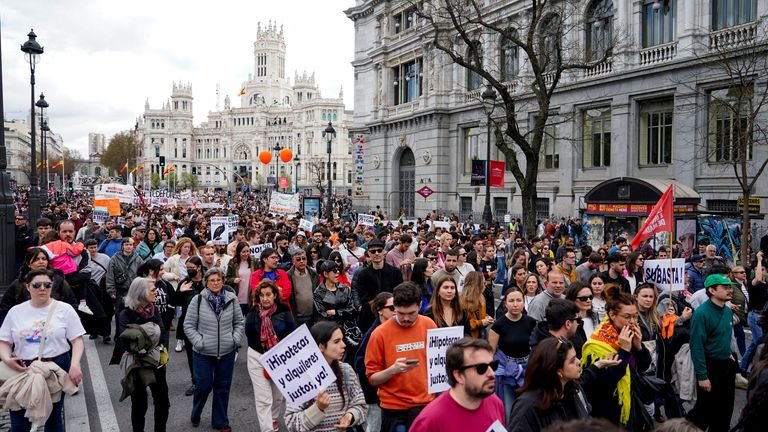
The Housing Crisis: Another Social Storm
Before the anti-government sentiment could subside, another protest focusing on social welfare took place in Madrid on Sunday. In recent years, the housing problem in Spain’s major cities has become increasingly severe, with soaring rents and a shortage of available properties forcing many young people and middle-class families out of city centers. Although the Sánchez government previously introduced a Housing Law (Ley de Vivienda) to stabilize the market, its effects have been minimal.
Many landlords are opting to convert their properties into more profitable short-term tourist rentals, further exacerbating the supply shortage in the long-term rental market. This has caused housing costs and pressure on the general public to continually rise. The housing issue has evolved from an economic topic into a social crisis sparking nationwide discontent.
A Dual Challenge of Politics and Public Welfare
Analysts point out that the current threat to the Sánchez government is not just the political battles within parliament, but a combination of the social sentiment reflected in street protests and harsh economic realities. From political controversies over the amnesty law to widespread housing anxiety, internal conflicts within Spanish society are intensifying.
These two closely-timed protests, though different in theme, collectively reveal the complex predicament Spain currently faces. The interplay of political opposition, judicial disputes, and the housing crisis is becoming a crucial test for the stability of Sánchez’s coalition government and signals potential flashpoints for Spain’s political future.
