In a program on the Spanish media outlet COPE, economic analyst Marc Vidal delivered a sharp critique of the nation’s current economic model, which relies on tourism. He argues that this model is ‘creating industrial bankruptcy’ and is one of the root causes of youth poverty and the housing crisis.
The ‘Quantity Over Quality’ Tourism Dilemma
Vidal points out that the recent growth in Spain’s tourism industry is primarily reflected in ‘an increasing number of tourists’ rather than a genuine upgrade of the sector. He criticizes this development model for its heavy reliance on ‘quantity over quality.’ Although total tourist spending is rising, this doesn’t mean Spain is offering higher-value products or services. The entire industry is still built on low wages, highly seasonal jobs, and precarious labor contracts. As a result, many tourism workers earn incomes far below the national average and struggle to secure mortgages from banks due to a lack of stable income proof.
The Deep Link Between Economic Structure and the Housing Crisis
Vidal directly links the current housing crisis to this unhealthy economic structure. He explains, ‘When a society lacks demand from people with stable purchasing power, developers have no incentive to build new homes. The fewer properties available on the market, the higher the prices will naturally be.’ In his view, public discourse often points the finger at investment funds, foreign buyers, or tourist apartments, but this overlooks the deeper structural problem. The core issue, he argues, is that Spain’s decades-long over-reliance on a low-cost tourism economy has prevented the younger generation from accumulating wealth, stripping them of their ability to buy a home.
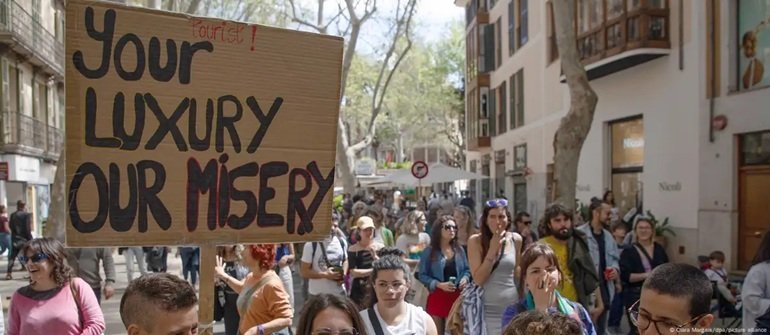
The Reality: Soaring Prices and Stagnant Purchasing Power
Real-world data corroborates Vidal’s perspective. According to data from the property portal Idealista, housing prices in Spain are hitting record highs. As of April 2024, the national average price reached €2,748 per square meter, while in popular regions like the Balearic Islands and Madrid, this figure soared to €5,252 and €4,707, respectively. Although a report by Neinor Homes shows that 97% of homebuyers are Spanish residents, with 62% of households having an annual income below €50,000, wage growth has failed to keep pace with the rise in property prices. This places unprecedented pressure on the average middle class, especially young people, when trying to buy a home.
Spain’s Social Contradiction and a Warning for the Future
Vidal concludes that Spain is caught in a major social contradiction: it is one of the world’s most visited countries per capita, yet a large number of its own young people are unable to live independently for economic reasons, often relying on financial support from their parents. He warns that if Spain does not fundamentally change its production model and continues to rely solely on attracting ‘more tourists’ to sustain superficial economic growth, the housing crisis and social inequality will only intensify.
