Recently, during an ecological restoration project on La Almadraba beach in Alicante, Spain, construction workers made a major archaeological discovery: a remarkably well-preserved marble female head from the Roman era was accidentally unearthed.
In a statement, Alicante’s Councilor for Culture described it as “a cultural and historical discovery of incalculable value,” emphasizing that the sculpture is “one of the most central and important Roman sculptural finds in the history of the city and the entire province.”
Statue’s Features and Artistic Value
According to official data, the marble head measures 22.22 cm in height and 19.78 cm in width. Despite minor wear on the face, its overall structure and details are remarkably well-preserved. The sculpture exhibits a typical Hellenistic artistic style, with an elaborate hairstyle featuring wavy curls parted in the middle and gathered into a bun at the back of the neck. Archaeological experts believe this idealized representation aligns with the sculptural canons for the goddess of love, Venus, or other important female deities in Roman mythology. During the Roman Empire, Venus was highly revered as the ‘divine mother’ of the Roman people. Regional heritage experts have praised the piece as one of the most technically accomplished masterpieces ever discovered in the vicinity of the ancient Roman city of Lucentum (the predecessor of Alicante).
Unveiling the History of a Roman Elite Area
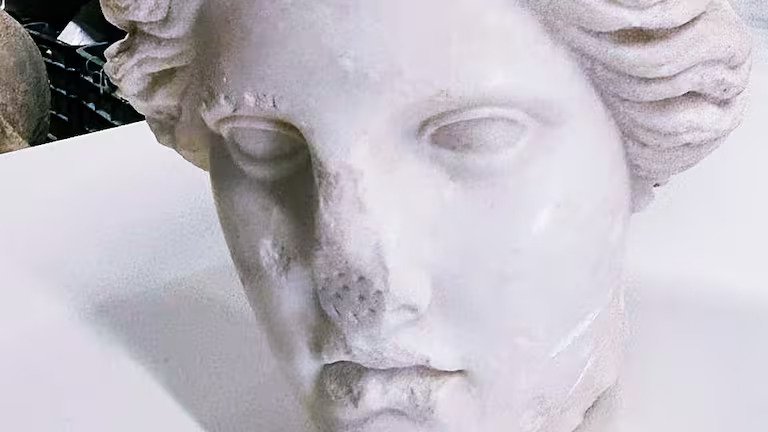
The discovery of this statue provides strong new evidence for the historical significance of the La Almadraba beach area. The archaeological team notes that the statue’s size and craftsmanship suggest it was likely an artwork used to adorn the private villa of a Roman aristocrat. This inference confirms that this area, adjacent to Tossal de Manises (the center of ancient Lucentum), was an extremely affluent residential district for the elite class some two thousand years ago. During the prosperous reign of Emperor Augustus, Lucentum, as a Roman municipality, had temples, a forum, and comprehensive public facilities. The original owner of the statue was most likely a member of the top ruling class who owned a large seaside estate at the time.
Future Research and Public Exhibition
Next, the archaeological department will conduct more in-depth research on the statue. A key objective is to identify the origin of its marble. If it can be confirmed that the material is not local but high-quality marble transported by sea from places like Italy or Greece, the artifact’s historical value and its importance within a European context will be further enhanced.
According to the Alicante City Council, after the necessary cleaning, registration, and documentation are completed, the statue, nicknamed the ‘Venus of the Beach,’ will be permanently housed and displayed to the public at the City of Alicante Museum (MUSA), located within the Santa Bárbara Castle (Castillo de Santa Bárbara).
