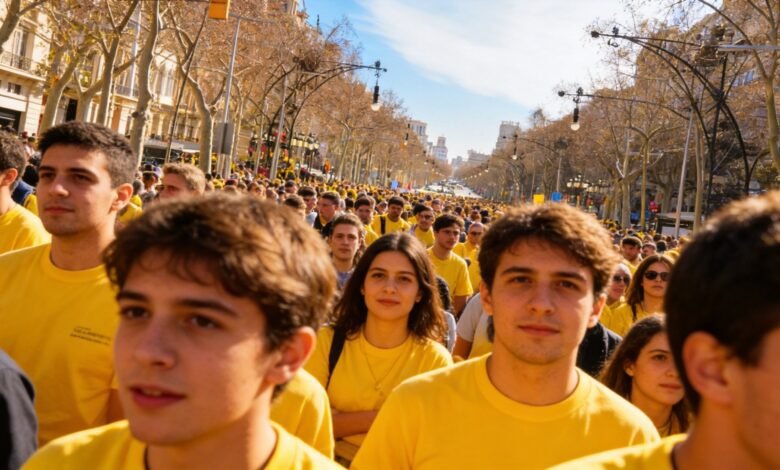
Following a wave of teacher strikes in Spain’s Catalonia and Valencian Community, the education sector in the Community of Madrid is now on high alert. Several teachers’ unions and organizations jointly announced on Wednesday evening that, due to the breakdown of long-term negotiations with the regional government, they plan to launch an indefinite, region-wide strike on the first day of the 2026/2027 school year. This decision marks a formal escalation of a three-year-long conflict with the Madrid government, led by Isabel Díaz Ayuso.
The Three Core Demands Behind the Strike
According to information disclosed by the teachers’ unions, this large-scale strike action is primarily triggered by three long-unresolved issues:
- Excessive Class Sizes: The unions point out that classrooms in Madrid’s public schools are commonly overcrowded. This severely limits teachers’ ability to provide high-quality, personalized education and makes it difficult to guarantee teaching quality.
- Inadequate Salaries: Despite Madrid being one of the most expensive regions in Spain, its public school teachers’ salaries are among the lowest in the country. The unions argue that the current pay does not match the teachers’ professional contributions and the high cost of living.
- Excessive Teaching Hours: Madrid is currently the only autonomous community in Spain that has not restored teaching hours to the levels seen before the austerity cuts of the ‘Wert era’. The reasonable workload protections of 18 teaching hours per week for secondary school teachers and 23 for primary school teachers have yet to be reinstated, leaving frontline educators in a state of chronic overload.
A United and Escalating Strike
The strike was jointly initiated by the grassroots organization ‘Menos Lectivas’ and the CGT union, and it has received strong backing from Madrid’s two main unions, the UGT (General Union of Workers) and the CCOO (Workers’ Commissions). The latter two have explicitly stated they will organize a full-scale strike involving all teachers from the very first day of the new school year. This signals the imminent start of a highly coordinated and unprecedented protest.
From Regional Protest to a Push for National Action
The Madrid teachers’ action is not an isolated event but a reflection of systemic problems within Spain’s national public education system. The organizers are not content with applying pressure only in the Madrid region; they seek to escalate this protest into a nationwide, unified action. According to the plan, a ‘National Assembly for Public Education,’ gathering frontline teacher representatives from all over Spain, will be held on June 13th of this year at the La Prospe People’s School in Madrid. The meeting aims to discuss cross-regional joint protest strategies to collectively address the common challenges facing education systems everywhere and build greater social momentum.
Potential Impact on the Education System and Parents
The decision to hold an indefinite strike casts a large shadow over the start of the 2026/2027 school year. This situation has left many parents anxious, worried that their children’s education will be severely disrupted. In the Valencian Community, which also experienced teacher strikes, parents’ associations have already expressed strong discontent over a potential ‘paralysis’ of the school term and have urged the government to engage in productive negotiations with the unions as soon as possible. This labor dispute in Madrid not only tests the governance of the local administration but also pushes deep-seated issues in Spanish public education—such as unequal resource distribution, teacher compensation, and working conditions—back into the public spotlight.
