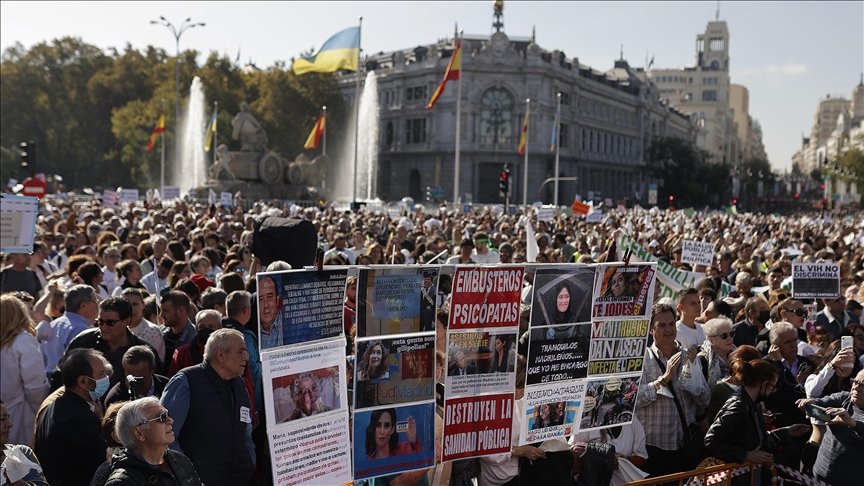
On May 31, 2026, Spain’s capital, Madrid, once again became the epicenter of a massive protest. Nearly ten thousand people answered the call to take to the streets, demanding the government defend the public healthcare system and oppose the continuous decline in its service quality. This demonstration highlights the growing local concern over social issues such as healthcare, housing, and the cost of living.
Four Marches Converge at Cibeles
This large-scale march, initiated by the ‘Platform of Neighborhoods and Towns of Madrid,’ garnered support from over 100 community organizations, social groups, and residents’ associations. Demonstrators, rallying under the slogan ‘Saving our public healthcare saves us all,’ voiced their deep dissatisfaction with the current medical situation.
On the day, columns of protesters departed from four different locations: Atocha, Plaza de Colón, Sevilla, and the Dalí statue at Plaza de Felipe II, ultimately converging at the iconic Plaza de Cibeles. This marks the fifth major healthcare-themed protest organized by the platform in recent years.
A Million on Waiting Lists as Healthcare System Buckles
Organizers point out that Madrid’s public healthcare system is facing unprecedented pressure. This is evident in the ever-lengthening waiting lists, a severe shortage of family doctors and pediatricians, and the increasing difficulty of booking appointments.
According to resident representatives, booking an appointment with a family doctor often requires a wait of several weeks. More alarmingly, in the Community of Madrid, with a population of about 7 million, over one million people are on medical waiting lists. This figure exposes the vast gap between public healthcare resources and public demand.
The Plight of Healthcare Workers and Brain Drain
Healthcare professionals participating in the protest also expressed their frustration with their working conditions. A nursing assistant from the Hospital 12 de Octubre stated that while Madrid is one of Spain’s most economically developed regions, its healthcare workers receive comparatively low salaries and have long faced understaffing issues.
Poor working conditions and immense pressure have led many skilled medical professionals to leave Madrid, further exacerbating the staffing crisis in the public healthcare system and creating a vicious cycle.
Privatization Policies Blamed
The demonstration received on-site support from representatives of major political parties and unions, including the Spanish Socialist Workers’ Party (PSOE), Podemos, the General Union of Workers (UGT), and the Trade Union Confederation of Workers’ Commissions (CC.OO.).
Several speakers at the rally strongly criticized the regional government of the Community of Madrid, accusing it of persistently pursuing healthcare policies that favor collaboration with private institutions. They argue that this practice effectively diverts public funds and resources to the private healthcare sector, thereby weakening the capabilities of public hospitals and primary care centers, and is the root cause of the current crisis. Society is now closely watching to see how the future of Madrid’s public healthcare system will be reshaped.
