Young Man’s Encounter with Giant Snake Sparks Panic Among Villagers
The incident occurred on the afternoon of May 31, 2026, near the agricultural area of Desamparados in Orihuela, Spain. A 22-year-old local man, Heri, came across a massive snake while out for a walk. According to his description, the snake was enormous, with a girth “as thick as an adult’s arm.”
Startled, Heri quickly took a photo with his phone as proof before immediately leaving the area. His 69-year-old uncle, Antonio, later stated that Heri was extremely frightened by the encounter. The scene was also witnessed by Heri’s 71-year-old great-aunt, who confirmed her grandnephew’s panicked state.
Photo Ignites Community Concern, Reveals Mystery of Missing Animals
Worried, Antonio posted his nephew’s photo to a local community chat group and officially reported the sighting to the relevant municipal authorities, requesting an intervention. He noted that both he and many old-time farmers who have worked the land for generations had never seen a snake of such a size in their lifetimes.
The photo’s circulation provided a new explanation for a mystery that had puzzled villagers for months. Local residents reported a sharp decline in the population of wild rabbits and mice in recent months, to the point where they had almost “vanished.” The appearance of the giant snake led to widespread speculation that it was the cause of the disappearance of these small mammals.
Experts Clarify: It’s the Native Montpellier Snake
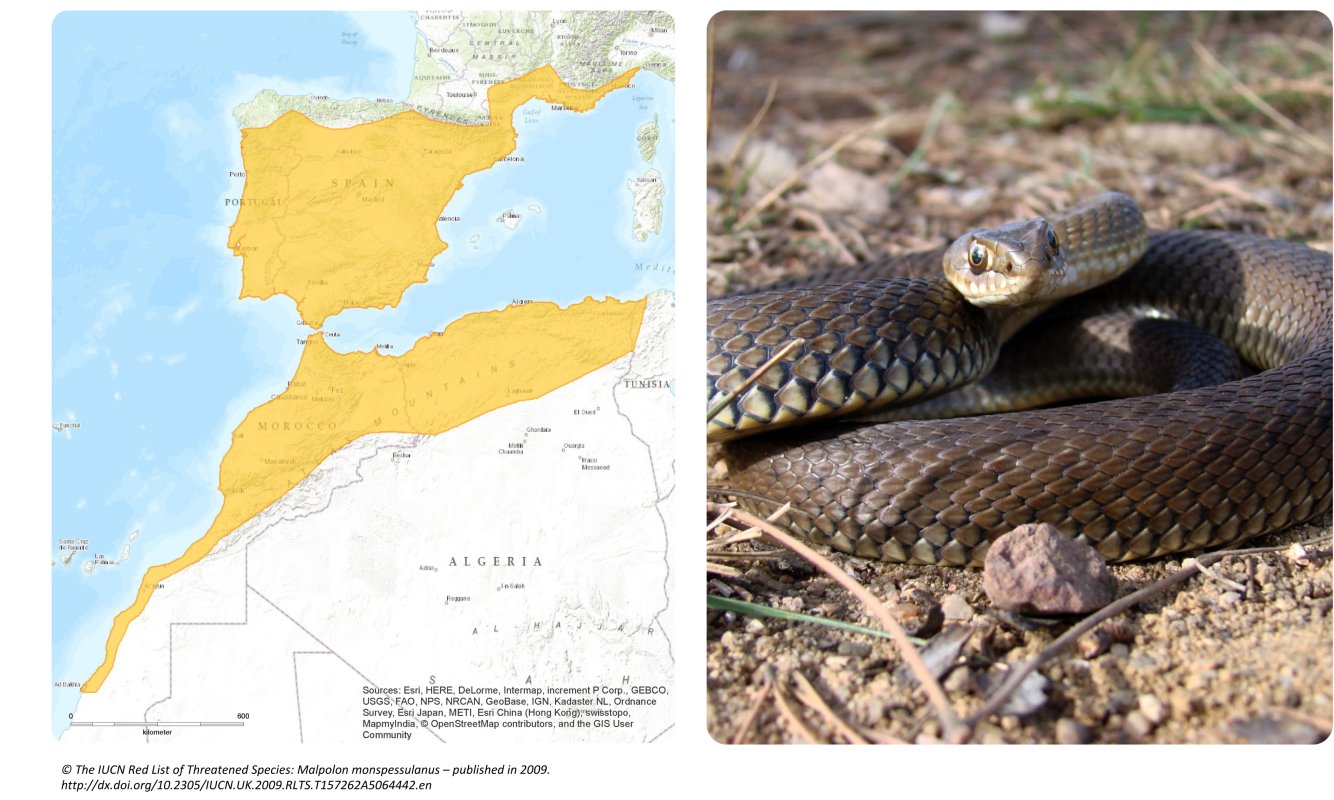
In response to growing public anxiety, local media and biology experts quickly intervened to clarify the situation. Based on the photograph and description, experts confirmed the snake to be a native species: the Montpellier snake (Malpolon monspessulanus).
Experts explained that the Montpellier snake is one of Europe’s largest snake species and can indeed grow to impressive sizes. An interesting detail is that before reporting to the authorities, Antonio had used artificial intelligence (AI) to identify the snake, and the AI’s conclusion perfectly matched that of the experts.
An Ecological “Guardian”: Venomous but Harmless to Humans
Experts further emphasized that although the Montpellier snake is venomous, its fangs are located at the back of its throat, classifying it as a rear-fanged snake. This anatomical feature allows it to inject venom when biting small prey but makes it nearly impossible for it to pose a fatal threat to large-bodied humans.
More importantly, the Montpellier snake plays a crucial role in the local ecosystem. They are efficient predators that feed on large numbers of rodents (like mice) and other animals that can damage crops, making them a “great asset” in maintaining agricultural ecological balance. The incident ultimately transformed from a scare into an educational opportunity about local ecology for the residents.
