What is an Energy Performance Certificate?
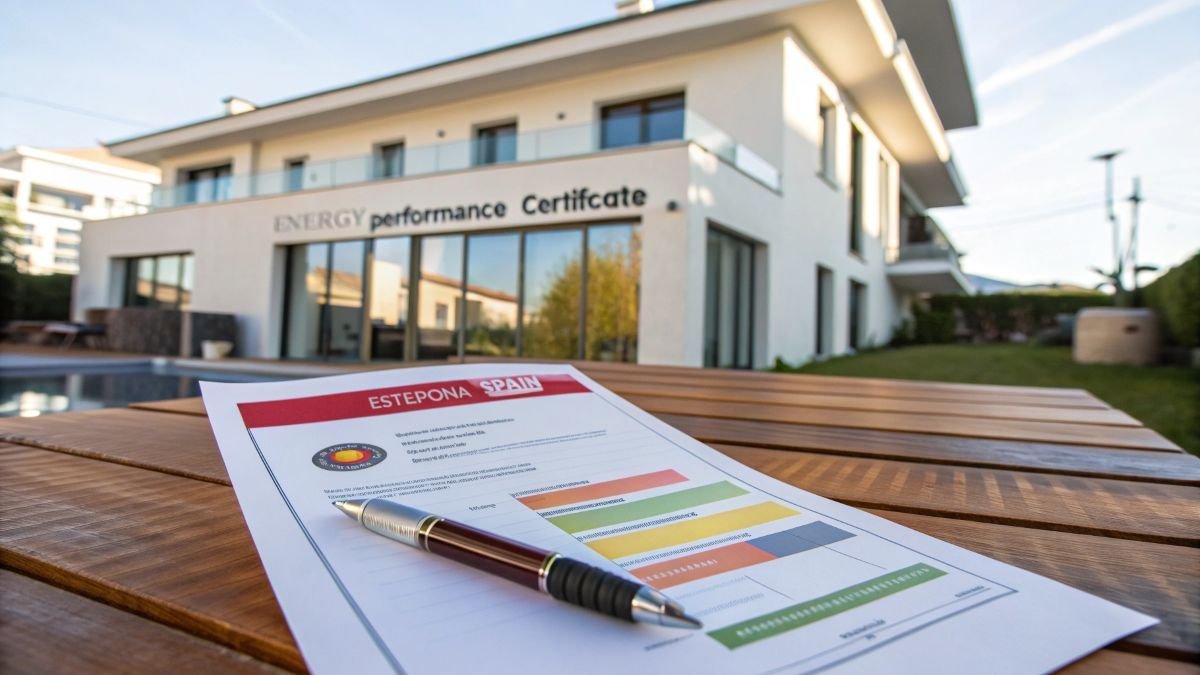
The Energy Performance Certificate, known in Spanish as the “Certificado de eficiencia energético”, is a legal requirement derived from an EU directive aimed at reducing building energy consumption and environmental pollution. This document is issued by an authorized professional technician and must be registered with the government of the corresponding autonomous community. It visually represents a property’s (whether residential or commercial) energy efficiency on a scale from A (most efficient) to G (least efficient), providing a standardized basis for assessing its environmental performance and potential energy costs.
Division of Legal Responsibility in Transactions
Spanish law clearly states that when selling or renting a property, the owner (seller or landlord) must possess and provide a valid Energy Performance Certificate to potential buyers or tenants. This regulation aims to protect the right of buyers and tenants to be informed, allowing them to consider energy efficiency as a factor in their decision-making.
The legal responsibility falls entirely on the property owner. If a seller fails to provide this certificate, they may face fines from the local government. In contrast, there are no legal penalties for the buyer or tenant. Even if a transaction is completed without the certificate, the legality of the property’s ownership (propiedad) and right of use (uso) is completely unaffected.
Potential Consequences of Lacking a Certificate
Although there are no penalties for the buyer, purchasing a property without an energy certificate still carries subsequent risks. The main issue is that when the new owner decides to sell or rent out the property in the future, the legal obligation to provide an energy certificate transfers to them. At that point, they will have to bear the cost of hiring a technician to complete the assessment and issue the certificate.
While some parties in private transactions might overlook this document due to a lack of awareness or concern, this does not absolve the seller of their legal liability. With growing awareness and stricter enforcement of these regulations, providing a compliant energy certificate is the best practice to avoid future legal risks and fines.
How to Obtain an Energy Certificate
To obtain an Energy Performance Certificate, the property owner typically needs to contact a qualified certified technician (técnico certificador), such as an architect or engineer. The technician will conduct an on-site inspection of the property, collecting data on insulation, windows, doors, heating, and cooling systems. They then calculate the energy rating and issue the certificate. Finally, the certificate must be submitted for registration to the competent authority in the property’s autonomous community to become officially valid.
For example, in the Community of Madrid, relevant information can be found on its official government website. In the Autonomous Community of Catalonia, the Catalan Institute of Energy (Institut Català d’Energia, ICAEN) is responsible for managing these matters.
