Spain’s Unique Distress Code: The Helmet on the Ground
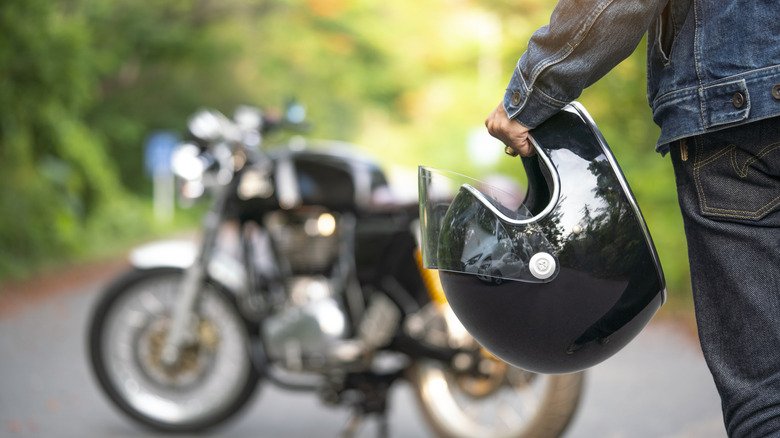
On Spanish roads, if you see a motorcycle parked on the roadside with a helmet placed on the ground next to it, this is not a casual act but a widely accepted distress signal. Although Spain’s General Circulation Regulation (Reglamento General de Circulación) does not officially list this as a standard call for help, it has become a clear consensus within the local motorcycle community. Other riders who see this will understand that a fellow rider is in trouble—whether due to a mechanical failure or physical discomfort—and will typically stop to offer assistance. This reflects the strong spirit of unity and mutual support within the biker community.
The Pan-European “Yellow Cloth Signal”
Unlike the custom in Spain, motorcyclists in some other European countries, such as Germany, Denmark, and Norway, use another long-standing distress code. When facing an emergency, they hang a yellow cloth on the motorcycle’s handlebars. This tradition originated in an era before smartphones were common and served as an efficient, silent way to call for help. The color yellow was chosen for its high saturation, making it highly visible to other drivers even in low-light conditions like dusk, dawn, or bad weather, thus ensuring timely assistance. This signal is not only practical but is also considered a part of the biker cultural identity.
The Helmet: A Lifesaver Beyond a Distress Signal
Whether used as a prop for a distress signal or for its primary function, the helmet is of irreplaceable importance to a motorcyclist. It is the most crucial piece of gear for ensuring riding safety. Statistics show that in motorcycle accidents, about 80% of fatalities are caused by head impacts. Correctly wearing a compliant helmet can reduce the risk of fatal injury by nearly 30%. On a motorcycle, which lacks the protection of a vehicle body, the helmet is the rider’s only “body armor” and the last line of defense for protecting their life.
Safe Riding: How to Choose a Compliant Helmet
Given the extreme importance of helmets, safety experts advise riders to prioritize protective performance when choosing one. Compared to a three-quarter helmet that only covers part of the face, a full-face helmet that provides comprehensive protection for the chin is the safer choice. In terms of materials, helmets made of composite fiber generally offer superior protection. Additionally, consumers must confirm that the product has the EU E-mark label, which indicates that the helmet meets European safety standards. Choosing a compliant, high-protection helmet is a direct demonstration of taking responsibility for one’s own life.
