460-Million-Year-Old Marine Fossils in Madrid Confirm Ancient Deep-Sea Past
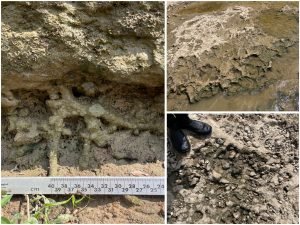
A recent paleontological study has confirmed that modern-day Madrid, the capital of Spain, was once an area covered by the sea in the distant past. A team of scientists from the Complutense University of Madrid (UCM) and the Geosciences Institute (IGEO, CSIC-UCM) of the Spanish National Research Council has discovered marine fossils dating back approximately 460 million years, completely rewriting the region’s paleontological history.
A Major Discovery: Madrid’s Oldest Evidence of Marine Life
The research team, led by paleontologists Sara Romero and Juan Carlos Gutiérrez-Marco, successfully extracted a collection of exceptionally valuable fossils from Paleozoic shale in the Patones and El Atazar areas, north of Madrid.
These fossil remains belong to various marine invertebrates, primarily including trilobites, brachiopods, mollusks, and graptolites. This discovery represents the oldest recorded evidence of marine life within the Community of Madrid.
A Geological Miracle: Fossils That Survived Immense Change
These fossils are considered a miracle by the scientific community because the rock layers they were found in have undergone extremely complex geological evolution. The ancient rock strata of the Central System, where the fossils are located, have endured intense deformation and metamorphism during prolonged tectonic movements, which typically makes the preservation of complete biological traces very difficult.
Prior to this, the only similar discovery in the area dated back to 1864, when geologist Casiano de Prado found fossils of marine arthropods in Puebla de la Sierra. This new find, after more than a century and a half, is thus invaluable.
Academic Significance: Reshaping Paleontological Knowledge of the Iberian Peninsula
The research team pointed out that these rock layers are largely covered by younger geological materials throughout most of the Community of Madrid, only becoming exposed on the surface in specific high-mountain areas, which increases the difficulty of discovery. The fossils found date back to the Middle Ordovician period, about 460 million years ago, providing solid physical evidence for the hypothesis that ‘Madrid was once a deep sea.’
This research not only provides crucial, firsthand geological data for exploring the marine ecosystems of the Iberian Peninsula from hundreds of millions of years ago but also completely updates the scientific understanding of Paleozoic paleontology in the northern mountains of Madrid and the neighboring Guadalajara region. The findings were officially announced on May 29 at the 80th Scientific Session of the Geological Society of Spain and published in the specialized journal Geogaceta.
