Eurozone Economy Unexpectedly Contracts
A report released by Eurostat indicates that the Eurozone’s economic performance in the first quarter of 2026 fell short of expectations, with its Gross Domestic Product (GDP) contracting by 0.2% quarter-on-quarter. This figure not only missed market consensus but also reversed the 0.2% growth recorded in the fourth quarter of 2025. This assessment, the first since Bulgaria officially became the 21st member of the Eurozone, suggests that the European economy as a whole is facing new downward pressure.
Volatile Irish Economy is the Main Drag
Analysis points to the sharp decline in the Irish economy as the main reason for the Eurozone’s contraction this quarter. Data shows that Ireland’s GDP plummeted by 12.1% in Q1 2026, significantly impacting the overall economic figures for the Eurozone. The country’s economy is highly dependent on large multinational pharmaceutical companies. As the export boom previously driven by factors like surging drug demand subsides, related industrial activity has dropped by 27.1%, directly causing severe fluctuations in economic data. Meanwhile, ongoing tensions in the Middle East and an uncertain global trade environment have further weakened economic confidence in Europe.
Spain Bucks the Trend, Leading Major Economies
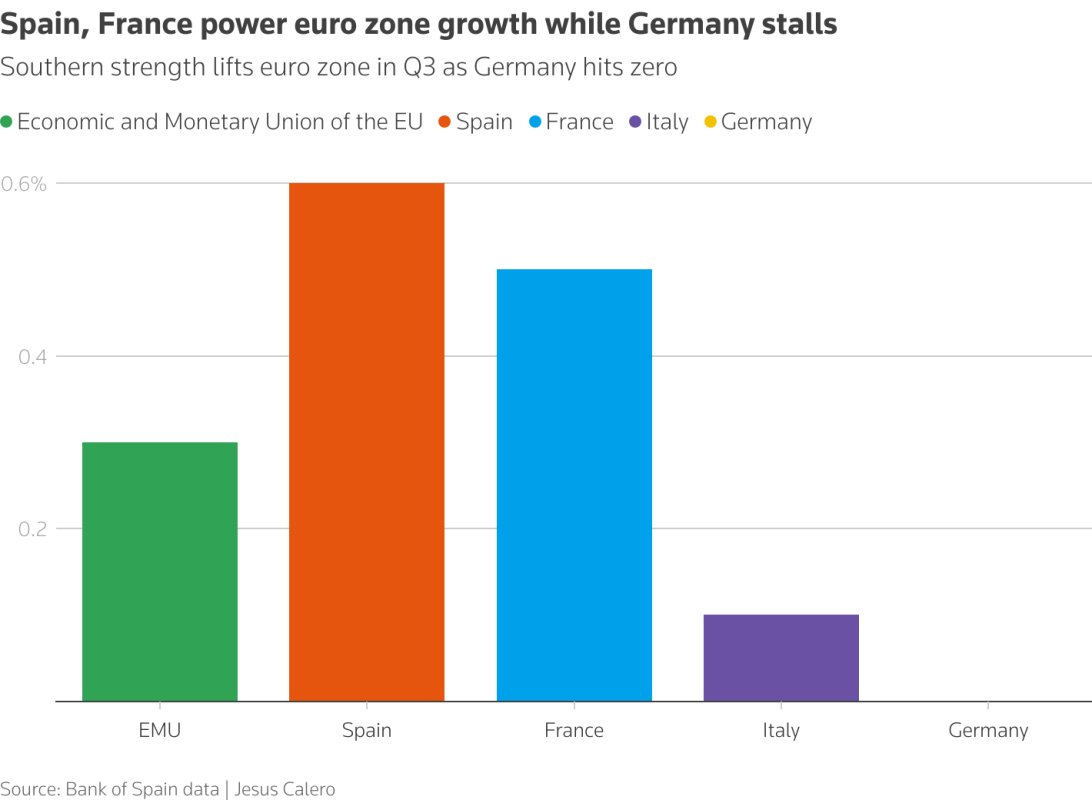
Against the backdrop of overall weakness in the Eurozone, the Spanish economy has demonstrated strong resilience. In the first quarter of 2026, Spain’s GDP grew by 0.6% quarter-on-quarter. This growth rate not only ranks among the top of the major Eurozone economies but is also double the rate of Germany and Italy. In contrast, the economy of another major player, France, contracted by 0.1%. During the same period, the fastest-growing countries within the Eurozone were Denmark (+1.9%), Estonia (+1.1%), and Malta (+1.1%). For comparison, the US economy grew by 0.4% in the same quarter.
Job Market Stable for Now, but Outlook is Worrying
Despite the decline in macroeconomic data, the Eurozone’s job market remained superficially stable in the first quarter. Total employment saw a slight increase of 0.1%, reaching approximately 176 million people. However, a warning sign is the 0.2% decrease in total hours worked, which may indicate a weakening in corporate hiring demand. On an annual basis, the Eurozone’s annualized economic growth rate has slowed significantly from 1.2% to 0.3%. Market analysts are closely monitoring subsequent economic indicators to assess whether the current slowdown is a short-term fluctuation or the beginning of a long-term stagnation.
