Project Falco: Protecting Ancient City Heritage with Birds of Prey
To address the growing problem of urban pigeons, the Murcia City Council in Spain has officially launched a biological control initiative called “Proyecto Falco” (Project Falco). The project aims to control the rampant pigeon population in the historic city center in a natural and ecological way by introducing their natural predators. According to municipal data, there are currently around 8,000 pigeons in the city center, and their acidic droppings are severely damaging precious historical buildings and public facilities.
As a core part of the project, the Murcia City Council has partnered with four authorized breeding centers in the Andalusia region to introduce four new Mediterranean peregrine falcons (Falco peregrinus brookei) this year. This subspecies is native to the Iberian Peninsula and is genetically identical to the wild population in Murcia. This initial collaboration will last for two years, with the breeding centers providing the captive-bred falcons free of charge.
The ‘Hacking’ Reintroduction Technique
To ensure these birds of prey successfully settle in the city, the project will use a professional technique known as “hacking.” Technicians will install special nesting boxes at strategic high points in the urban core and place the young falcons inside. The chicks will be fed by specialists until they are old enough to fly.
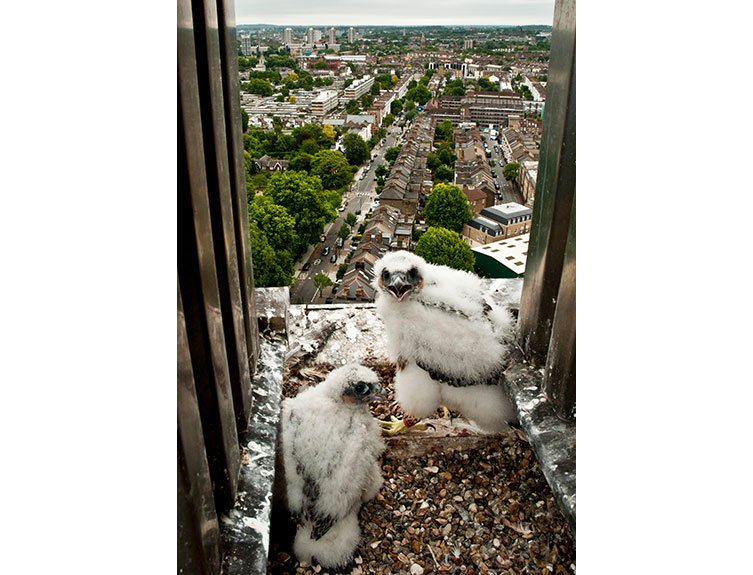
This process is designed to make the young falcons recognize the urban environment as their “birthplace” during a critical developmental stage, thereby establishing a territorial bond. A veterinary team from the city’s Animal Protection Center will supervise the entire process, scientifically tagging and tracking all released falcons to monitor their health and adaptation.
A Dual Strategy: Ecological Control and Species Conservation
“Project Falco” has two strategic objectives. The primary goal is to use the deterrent presence of the falcons to disperse the overly concentrated pigeon flocks. This offers a more environmentally friendly and sustainable alternative to traditional control methods. Previously, the municipality had to remove approximately 4,000 pigeons annually through trapping to maintain a balanced population.
Secondly, the project is also a proactive species conservation effort. By reintroducing a rare native bird of prey into the urban environment, it not only aids in the species’ recovery and proliferation but also helps restore a link in the urban ecosystem, enhancing local biodiversity.
Long-Term Collaboration and Future Outlook
Project Falco actually began in June 2023, and this introduction of new falcons is a continuation of the long-term initiative. Currently, the project’s existing male falcon is about three years old, and the female is two. Given that peregrine falcons reach sexual maturity at four years for males and three for females, technicians expect the pioneering pair to enter their breeding period by next year.
The project leaders are hopeful that the falcons will soon begin to pair up and reproduce freely in Murcia’s skies, eventually establishing a self-sustaining urban raptor population that will provide a long-lasting natural defense for the historic city.
