Pet Travel Rules in Spain: Legal Framework and Enforcement
Spain does not have a specific law solely dedicated to transporting pets in vehicles. Instead, this issue is managed within the overall safety framework of the General Circulation Regulation (Reglamento General de Circulación). Article 18.1 of this regulation states that a driver must always maintain the necessary freedom of movement, a clear field of vision, and sustained attention to the vehicle to ensure their own safety, the safety of their passengers, and that of other road users.
Although the law does not explicitly prohibit pets from occupying the front passenger seat, the General Directorate of Traffic (Dirección General de Tráfico, DGT) strongly advises against it due to the high risk of distracting the driver. In practice, traffic police have the discretion to assess the situation on the spot:
- Minor Infraction: If a pet is found unrestrained by any device inside the vehicle, the owner may face a fine of around €100.
- Driver Distraction: If a pet is moving freely within the car and is clearly distracting the driver (e.g., sitting on the driver’s lap or moving around the dashboard), the fine increases to €200.
- Reckless Driving: In extreme cases, if the pet’s behavior is deemed to constitute a serious safety threat or reckless driving, the fine can be as high as €500, accompanied by a penalty of 6 points deducted from the driver’s license.
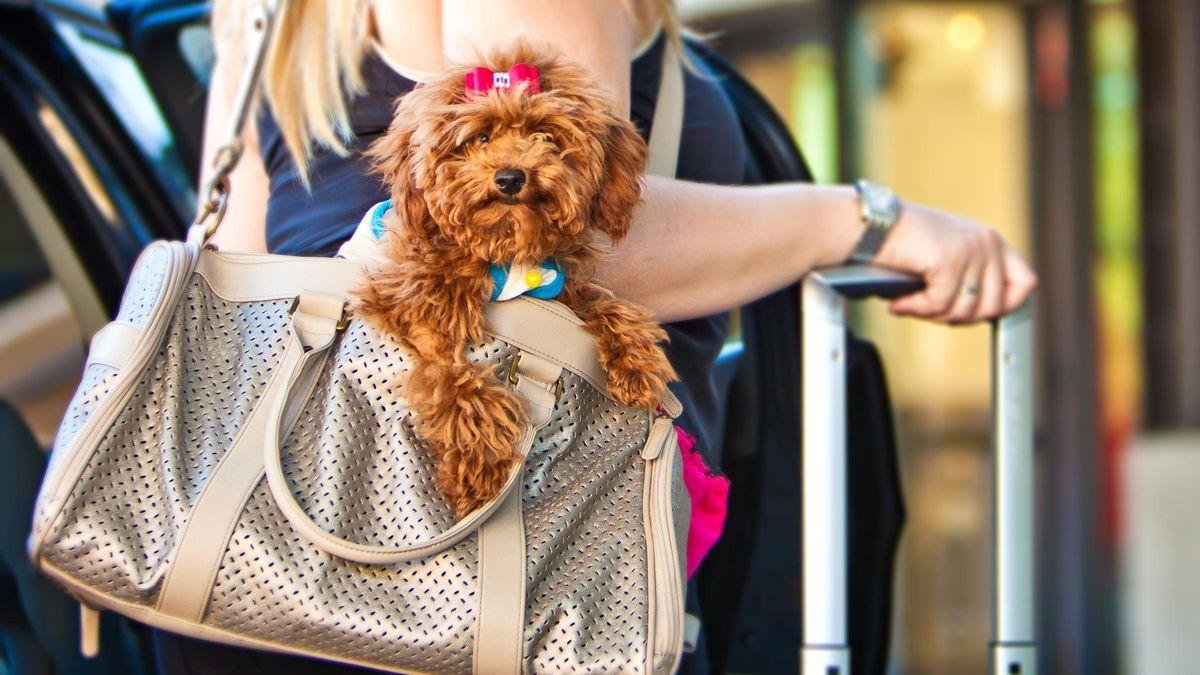
Potential Risks: From Distraction to Fatal Impact
Allowing a pet to move freely inside a car, especially in the front seat, creates multiple fatal risks.
First and foremost, front-seat airbags are designed for adults and deploy at incredibly high speeds. In a crash, a deploying airbag can inflict devastating or fatal injuries on a pet.
Furthermore, crash test data reveals that in a collision at 60 km/h, a 5 kg pet can generate an impact force equivalent to a 280 kg projectile due to inertia. This turns them into a deadly missile within the vehicle, posing a severe threat to all occupants.
Choosing the Right Safety Restraint
While using a restraint system for pets is mandatory, not all products on the market provide effective protection. The DGT specifically points out that attaching a standard leash to a pet’s collar is extremely dangerous. In the event of sudden braking or a collision, the immense force exerted on the collar can cause severe or fatal neck injuries.
While pet car seats or ‘booster seats’ are legal accessories available on the market, their safety performance can be inconsistent. The officially recommended option is a certified double-anchor harness (arnés de doble anclaje), which distributes impact forces more evenly across the pet’s chest and spine for better protection.
The Best Solutions Recommended by Traffic Authorities
Considering both public safety and protective effectiveness, Spanish traffic authorities regard using a pet carrier (transportín) as the safest and most reliable method for transporting a pet in a vehicle.
- Small Dogs/Cats: They should be placed in a carrier of an appropriate size. The carrier should then be positioned on the floor of the back seat, wedged in the space behind the front seats. This location effectively uses the gap between the front and rear seats to minimize carrier movement during a collision.
- Large Dogs: It is recommended to use a large carrier placed sideways in the vehicle’s trunk, right up against the back of the rear seats. Additionally, a sturdy metal partition grille should be installed between the trunk and the passenger cabin. This not only prevents the pet from being launched into the cabin during sudden braking but also aligns with the regulatory philosophy of many European countries (like Germany and Italy), which treat an unsecured pet as ‘improperly secured cargo.’ The goal is to use physical barriers to fundamentally prevent accidents.
