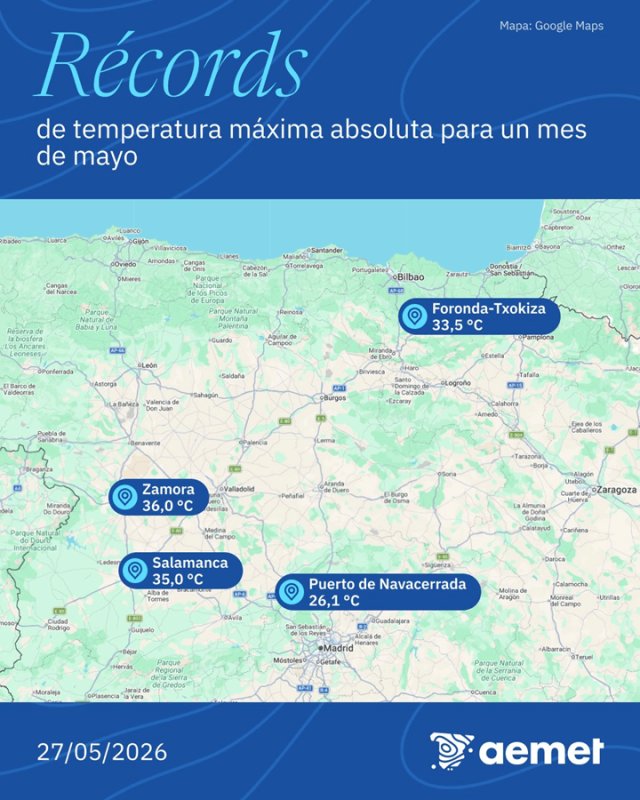
According to the latest quarterly meteorological outlook released this Wednesday by Spain’s State Meteorological Agency (AEMET), the entire country is “highly likely to experience a summer hotter than the seasonal average” in the upcoming summer of 2026 (June to August). This warning comes after the nation endured its second-warmest spring since records began in 1961, heightening public concern over extreme climate events.
2025 Climate Report Reveals a Stark Reality
On the same day, AEMET also released its “Report on the State of the Climate in Spain 2025.” The report indicates that 2025, alongside 2024, ranked as the third-warmest year in Spain since meteorological records began. Data shows the national average temperature for 2025 was 1.6 degrees Celsius above the 1991-2020 reference period, classifying it as an “extremely hot year.” The report highlights that during the year, Spain experienced only one brief and mild cold spell in January, with high temperatures dominating the rest of the time.
Long-Term Trend: An Overwhelming Increase in High-Temperature Records
The report provides an in-depth analysis of long-term climate data, revealing a series of alarming indicators. Since 1961, Spain’s national average temperature has risen by a cumulative 1.75 degrees Celsius. A more striking statistic is that for every daily minimum temperature record broken in the last decade, a staggering 32 daily maximum temperature records have been shattered, indicating a severe imbalance. Furthermore, the 12 hottest years on record have all occurred in the 21st century. In the past year (2025), the surface temperature of the Mediterranean Sea in Spanish waters broke the record high since data collection began in 1940, demonstrating extreme ocean heat storage.
A Systemic Crisis and Official Warnings
From the “second-warmest spring” to the forecast of a “highly probable hotter summer,” along with numerous record-breaking meteorological figures, everything indicates that global warming is pushing Spain into uncharted climate territory. This is no longer just seasonal heat but a systemic crisis that could profoundly impact the ecosystem, public health, agricultural production, and the power grid. Faced with the impending heatwave and potential drought risks, meteorological and civil protection authorities have issued serious alerts. The authorities are urging regional emergency response and health services to elevate heat and drought prevention to a strategic level. They also call on the public and outdoor workers to closely monitor AEMET’s high-temperature warnings, take necessary precautions to cool down, prevent heatstroke and other serious illnesses, and collectively face the severe challenges posed by climate change.
